Here is what the insurance company won't tell you: left on autopilot, a claim tends to get paid near its face value. A nurse strains her back, the file gets a reserve of $250,000, and everyone moves on. The real medical spend behind that number is often closer to $30,000, paid incrementally at roughly $1,500 to $2,000 a month, not as a lump sum. The gap between those two figures is decided in the first few weeks, and a well-run return-to-work policy is where you close it.
This guide keeps the full California legal framework you need to stay compliant, then layers on how an employer actually uses it to bring people back safely and hold claim cost down. At PCI Consultants, with 30+ years placing and directly managing workers' comp, we handle the claim for the life of the policy: the injured worker calls us, not the carrier, and we work the return-to-work plan from day one.
Key Takeaways
- A return-to-work policy is a cost-control tool, not just a compliance document; the faster an injured worker returns to suitable duty, the smaller the real claim cost
- Labor Code §132a and FEHA protect employees from retaliation and require reasonable accommodation, so your light-duty program has to be genuine, documented, and consistently applied
- California classifies capacity as regular, modified, or alternative work, and employers generally have 60 days after the P&S report to make a qualifying offer
- Direct, day-one claim handling, including an immediate urgent-care visit, creates an accurate medical record that protects you against later exaggeration
- Once premiums rise after a claim they rarely come back down, so shrinking the claim early protects your loss history and future premiums
California Laws That Govern Your Return-to-Work Policy
California employers face several overlapping statutes when bringing an injured worker back. Each carries distinct obligations, and complying with one does not mean you have complied with another. A broker who manages the claim directly keeps these aligned so a cost-saving light-duty move doesn't turn into a §132a or FEHA exposure.
Labor Code §132a
California Labor Code §132a is the anti-discrimination backbone of the comp system. It prohibits employers from:
- Discharging or threatening to discharge an employee for filing a workers' comp claim
- Discriminating "in any manner" against an employee who received a rating, award, or settlement
- Retaliating against an employee who testified in another worker's WCAB hearing
Penalties are real: a 50% increase in compensation up to $10,000, reinstatement, reimbursement for lost wages, and costs up to $250, plus misdemeanor exposure. Claims are filed with the WCAB within one year. The practical takeaway for an employer: an aggressive return-to-work push has to be paired with clean documentation, or a legitimate cost-control effort can be recast as retaliation.
FEHA — Fair Employment and Housing Act
The California Fair Employment and Housing Act (Government Code §12940) applies to employers with 5 or more employees and requires:
- Reasonable accommodation for employees with disabilities, including work-related ones
- A timely, good-faith interactive process when accommodation is requested or the need becomes apparent
- Non-discrimination based on disability in every employment decision
FEHA runs independently of workers' comp, so you can satisfy the comp system and still violate FEHA. The California Supreme Court confirmed in City of Moorpark v. Superior Court that §132a is not the exclusive remedy. For a 100+ employee healthcare operation, that independence is exactly why the interactive process should be documented every time.
CFRA and FMLA
Eligible employees may also be entitled to job-protected leave under CFRA and FMLA, up to 12 workweeks per year. Upon return, the DOL FMLA Fact Sheet #28 confirms the right to reinstatement to the same or an equivalent position. CFRA/FMLA and comp leave often run concurrently; employers who track them separately create duplicate liability, and they also lose sight of the clock that matters most for cost, which is time out of work.
The DWC and WCAB
Two state bodies oversee the process: the Division of Workers' Compensation (DWC), which monitors claims administration and resolves benefit disputes, and the Workers' Compensation Appeals Board (WCAB), the judicial body that adjudicates disputes. When we handle a claim directly, we are the ones interacting with these bodies on your behalf rather than leaving it to a carrier whose default is to pay and move on.
Why Return-to-Work Is Your Biggest Cost Lever
Without an advocate working the file, an insurer tends to pay a claim at or near face value and call it a win. That is fine for them; it is expensive for you, because in California once your premium rises after a claim it rarely comes back down, even after the claim resolves. A single mishandled nursing-home back injury can follow your experience rating for years.
Return-to-work is where you interrupt that. Here is the pattern we see repeatedly, and individual results vary:
- Day one: we evaluate the incident immediately and, where appropriate, send the injured worker to urgent care right away. That creates an accurate, timely medical record, which both gets legitimate injuries treated fast and protects you against a claim that gets exaggerated three months later.
- Weeks, not months: instead of leaving an injured nurse home on temporary disability, we work with the treating physician and your managers to move her into a light-duty role, receptionist-type or administrative work within her restrictions, within weeks. Every week she is back sharply cuts the real claim cost.
- The claim itself: the file that reads "$250,000" gets paid down at roughly $1,500 to $2,000 a month against real medical spend nearer $30,000. That difference is what protects your loss runs.
Genuine injuries get paid without a fight; that is the deal, and it is the right one. But exaggerated or fraudulent claims get investigated and contested through our fraud investigation work, which is another reason the day-one record matters. We are paid by commission from the insurer, not by how many claims you file, so we are not incentivized to let a claim balloon.
Your California Return-to-Work Policy: Step by Step
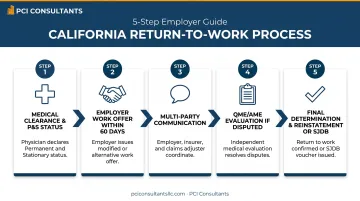
Step 1 — Medical Clearance and Work Status Report
The treating physician issues a Physician's Return-to-Work & Voucher Report to the claims administrator once the worker's condition is permanent and stationary (P&S). It classifies capacity into one of three categories:
| Category | Definition |
|---|---|
| Regular work | The employee's usual job, equivalent wages, within reasonable commute |
| Modified work | Regular work adjusted so the employee can perform all functions; at least 85% of pre-injury wages |
| Alternative work | Different work the employee can perform; at least 85% of pre-injury wages; reasonable commute |
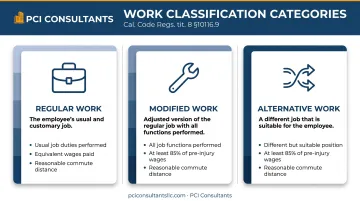
These definitions come directly from Cal. Code Regs., tit. 8, §10116.9. The modified and alternative categories are where your cost savings live, because that receptionist-type role for an injured nurse usually lands squarely inside them.
Step 2 — Employer Makes the Work Offer
Based on the report, you decide whether you can offer regular, modified, or alternative work within the restrictions. For injuries on or after January 1, 2013, Labor Code §4658.7 requires the offer within 60 days of the claims administrator receiving the P&S report, and the work must be available for at least 12 months. Miss that window and you may owe a Supplemental Job Displacement voucher you could have avoided.
Step 3 — Coordination Between All Parties
An effective return depends on tight communication between the employee, treating physician, managers, and claims administrator. Key items to exchange:
- Work history and current duties
- Documented medical restrictions
- Available modified or alternative positions
- Realistic recovery timeline
This coordination phase is where many claims stall and where cost escalates fastest. Because we handle the claim directly, we run this phase for you: pre-built light-duty options mapped to each restriction so a medical-only claim doesn't quietly convert into a lost-time claim while everyone waits. A formal return-to-work program turns this from ad-hoc scrambling into a repeatable policy.
Step 4 — Disagreements and QME/AME Evaluation
If the employee or the claims administrator disputes the treating physician's findings, a formal evaluation is triggered:
- QME (Qualified Medical Evaluator): a state-certified physician used when the parties cannot agree
- AME (Agreed Medical Evaluator): a physician agreed on by both parties' attorneys in represented cases
The QME or AME independently assesses restrictions, and that report carries significant weight on the return-to-work outcome. This is a common pressure point where exaggerated claims surface, and where our direct handling keeps the file honest.
Step 5 — Final Determination and Next Steps
Once the final medical determination is made, one of two things happens:
- You reinstate the employee to appropriate work, or
- If no suitable work exists, the employee may be entitled to Supplemental Job Displacement Benefits, and
- Permanent disability ratings are finalized and indemnity payments calculated
The Employee Rights You Have to Respect
A cost-focused return-to-work policy only works if it is genuinely compliant. The rights below are not obstacles; they are the guardrails that keep your light-duty program from becoming a §132a claim.
Reasonable Accommodations
Under FEHA and the ADA, returning employees with work-related limitations can request accommodations such as modified duties, adjusted schedules, ergonomic equipment, relocated work areas, or telework where essential functions still get done. The California Civil Rights Department confirms these obligations. You can refuse only for genuine "undue hardship" under Government Code §12926. In practice, offering a real light-duty role is usually both cheaper and safer than fighting the accommodation.
Job Reinstatement and Continued Medical Treatment
Employees generally have the right to return to their prior position or a comparable role at the same pay and benefits, with no injury-based demotion. And reinstatement does not end the claim: the carrier must keep covering doctor visits, therapy, medications, and equipment tied to the injury. Because we manage the file, those ongoing costs stay paid incrementally and documented, not delayed into a dispute.
Protection from Retaliation
Under §132a, adverse action tied to a claim or a disability is unlawful, and retaliation is rarely as obvious as a firing. It shows up as sudden negative reviews after a clean record, undesirable shift reassignments, or quiet benefit reductions. Under the Lauher standard the question is whether treatment was causally linked to the protected activity. This is exactly why we insist on written, consistent return-to-work decisions across your whole workforce.
Reviewing the Treating Physician's Report
Employees have the right to receive and review reports about their ability to return to work and their restrictions. If they disagree, unrepresented employees generally have 30 days to object and represented employees 20 days, and can request a QME or AME. Knowing these clocks lets us keep the claim moving instead of letting it drift.
When You Cannot Bring an Employee Back
The Mandatory FEHA Interactive Process
When restrictions prevent a return to the original role, you must engage in a formal interactive process, a documented, good-faith discussion of alternate or modified work. Government Code §12940(n) makes skipping it a standalone FEHA violation, independent of whether accommodation ultimately exists. The Court of Appeal confirmed in Wysinger v. Automobile Club of Southern California that failing to engage is itself unlawful. You cannot simply deny a return and move on.
Supplemental Job Displacement Benefits (SJDB)
Employees with permanent partial disability who cannot return to their prior employer are entitled to an SJDB voucher worth up to $6,000 (for injuries on or after January 1, 2013, under Labor Code §4658.7). It covers approved retraining, licensing and testing fees, tools and equipment within limits, and placement services. Crucially, the voucher is only owed when the employer fails to make a timely, qualifying offer, which is one more reason to hit that 60-day window.
Other Financial Options for the Worker
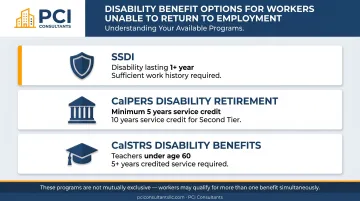
When a worker cannot return to any employment, several programs may apply alongside comp benefits: SSDI (disability expected to last at least a year, with sufficient work history), CalPERS Disability Retirement (generally 5 years of service credit), and CalSTRS Disability Benefits for teachers. These are not mutually exclusive, and applying for one does not disqualify a worker from another.
How a Directly Managed Program Changes the Numbers
A return-to-work policy on paper is worth little if no one drives it. Beyond the light-duty design itself, a few structural moves compound the savings for qualifying California employers, and not every business qualifies for each of them:
- Risk classification: we segment your workforce by actual risk, clerical versus hands-on clinical, so you are not overpaying premium on low-risk roles that rarely generate claims.
- High-deductible programs: for qualifying businesses, taking on a defined first layer (say the first $200K of a $500K program) can roughly halve annual premium, for example from $100K to $50K, with claim payments structured monthly, around $3,000, that stop when the condition resolves. It is actively administered, not set-and-forget, and it is not right for every employer.
- Consolidation and scaling: an owner running several nursing homes can often consolidate multiple locations into a single master policy for better terms, and smaller or newer operations can be grown into stronger programs over time.
Every one of these depends on the same discipline as your return-to-work policy: someone actively working the file rather than paying face value. That is what direct claims management buys you.
Frequently Asked Questions
How does a return-to-work policy actually lower my workers' comp costs in California?
By shortening time out of work and shrinking the real claim cost. A back-injured nurse kept home on temporary disability keeps the file open and the reserve high; the same nurse moved into a compliant modified or alternative role within weeks costs a fraction of that. Since paid claims drive your experience rating and California premiums rarely fall back down once they rise, cutting the claim early protects you for years. Individual results vary.
Can my employer legally deny an injured employee's return to work in California?
You may deny return to the same role only if a physician, confirmed by a QME or AME, determines the employee cannot perform their usual duties. Even then you must engage the FEHA interactive process, explore modified work options, and you cannot deny a return as retaliation. Denial without documentation is where §132a and FEHA exposure begins.
What are the three California return-to-work classifications?
Regular work (the usual job at equivalent wages), modified work (the usual job adjusted so the employee can perform all functions, at 85%+ of pre-injury wages), and alternative work (different work within restrictions, at 85%+ of pre-injury wages and a reasonable commute). Modified and alternative work, per Cal. Code Regs. tit. 8 §10116.9, are where most of your cost savings sit.
How long do I have to offer return-to-work under Labor Code §4658.7?
For injuries on or after January 1, 2013, you generally have 60 days after the claims administrator receives the permanent and stationary report to make a qualifying offer of regular, modified, or alternative work, and that work must be available for at least 12 months. Missing the window can trigger a Supplemental Job Displacement voucher you could otherwise avoid.
What is the interactive process under FEHA, and why should employers care?
It is a mandatory, good-faith discussion between employer and injured employee to explore accommodations or alternate work. Skipping it violates Government Code §12940(n) even if no suitable work ultimately exists. For an employer, documenting the process every time is cheap insurance against a standalone FEHA claim on top of the comp file.
We're a multi-location California healthcare operator. How do we start?
Send us two things: a copy of your current workers' comp policy and your five-year loss runs. That lets us review your return-to-work exposure, see where claims are converting to lost-time, and model whether risk reclassification, a consolidated master policy, or a high-deductible structure fits, for qualifying businesses. We respond within 24 hours, and once engaged we handle the claims directly for the life of the policy. Individual results vary.