The RTWSP is a state-funded, one-time payment for injured workers who meet very specific criteria. The Department of Industrial Relations created it to help workers who suffer a "disproportionate loss of earnings" after an injury. This guide breaks it down for both sides of the table: injured workers get a clear path through the application, and employers get the part the insurance company usually won't spell out, that by the time this voucher is issued, the expensive mistakes have already been made.
Key Takeaways
- The RTWSP is a one-time $5,000 payment for eligible injured workers in California.
- Eligibility requires a work injury on or after January 1, 2013, and receipt of a Supplemental Job Displacement Benefit (SJDB) voucher.
- The application is online-only and must be completed within one year of the SJDB voucher's issue date.
- For employers, the voucher only fires when you fail to accommodate an injured worker, and that failure is what drives real claim cost and sticky premiums.
What is the Return-to-Work Supplement Program (RTWSP)?
The Return-to-Work Supplement Program is a one-time, $5,000 state-funded payment in California for injured workers who have a permanent partial disability and cannot return to their former job. Its purpose is to help offset the wage loss that comes with a forced career change after a serious injury.
It matters to employers for a different reason. The RTWSP is downstream of a decision an employer already made, or failed to make: whether to bring an injured worker back in some capacity. In healthcare, where a lifting injury to a nurse or a CNA is one of the most common claims, that decision is usually the single biggest lever on what a claim actually costs.
RTWSP vs. SJDB Voucher
The Supplemental Job Displacement Benefit (SJDB) voucher is the key that unlocks RTWSP eligibility, but it serves a different purpose.
- SJDB Voucher: Worth up to $6,000 for retraining expenses like tuition, fees, books, and tools.
- RTWSP Payment: A $5,000 cash supplement usable for any expense, providing direct support during a career transition.
RTWSP vs. Permanent Disability (PD) Benefits
Permanent Disability benefits are a core part of a workers' compensation claim, but they are separate from the RTWSP.
- Permanent Disability (PD) Benefits: Payments from the employer's coverage that compensate for lost future earning capacity, based on a doctor's rating.
- RTWSP Payment: A separate, one-time payment from the state, triggered specifically by the worker's inability to return to their old job.
Who is Eligible for the RTWSP? A Detailed Checklist
Eligibility is strict, and every requirement must be met. The program is available only to injured workers in California.
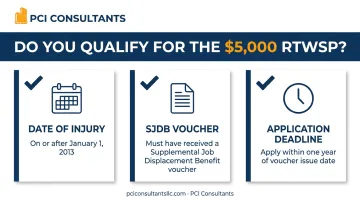
Core Eligibility Requirements
- Date of Injury: The workplace injury must have occurred on or after January 1, 2013.
- Receipt of SJDB Voucher: You must have been issued an SJDB voucher for that same injury.
- Application Deadline: You must submit your RTWSP application within one year of the date the SJDB voucher was served to you.
Understanding the SJDB Voucher
The SJDB voucher is the most important prerequisite. You qualify for it if you have a permanent partial disability from your injury and your employer did not offer you regular, modified, or alternative work within 60 days of your doctor declaring your condition medically stable.
That 60-day window is the whole ballgame for employers. The voucher is not a random state form; it is proof that a company had the chance to keep a trained employee and didn't take it. The $6,000 voucher can be used for:
- Tuition and fees at state-approved schools
- Books and required course materials
- Occupational licensing or certification fees
- Tools required for a training program
- Computer equipment (up to $1,000)
- Resume preparation and placement services
Once the worker has the voucher, the clock starts on the one-year deadline to apply for the separate $5,000 RTWSP payment.
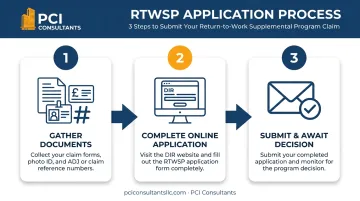
How to Apply: A Step-by-Step Guide
You can only apply for the RTWSP online through the California Department of Industrial Relations (DIR) website. Paper applications are not accepted. If you don't have internet access, use the computer kiosks at any DWC district office.
Step 1: Gather Your Documents
- Personal Information: Full name, address, and Social Security Number (SSN) or Individual Taxpayer Identification Number (ITIN).
- Workers' Compensation Adjudication (ADJ) Number: A case number assigned by the DWC, found on legal documents filed for your case.
- Workers' Compensation Claim Number: Assigned by the insurance company; it should appear on your SJDB voucher.
- Complete SJDB Voucher: A full, scanned PDF including every page, especially the final "proof of service" page showing when it was sent.
Step 2: Complete the Online Application
Navigate to the official DIR RTWSP application portal. Fill out every field carefully. A simple typo in your claim number can cause major delays.
Step 3: Submit and Await a Decision
After submitting, you'll receive an RTW confirmation number; keep it to track your status. The DIR typically decides eligibility within 60 days of a complete application, and if approved, payment is issued within 25 days of the decision.
Common Application Challenges and Misconceptions
Many eligible workers face delays or denials over simple, avoidable mistakes.
Common Challenges
- Submitting an incomplete SJDB voucher. Applicants often forget the signed proof of service page, which is what verifies the deadline.
- Struggling to find the ADJ number. Locate it with the EAMS case search tool on the DWC website or by contacting a DWC Information and Assistance Officer.
- Missing the one-year deadline. Applying even one day after the voucher's anniversary results in a denial.
Common Misconceptions
A frequent misconception is that the employer or their insurance carrier pays for the supplement. In reality, the RTWSP is funded by the state of California through a fund with an annual allocation of $120,000,000.
Another mistaken belief is that the supplement is part of a workers' compensation settlement. It is a separate state benefit, not a negotiable line item, and the worker must apply for it independently.
Beyond the Check: The Employer's Role in a Successful Return-to-Work System
Here's what the insurance company won't tell you: by the time a displacement voucher is issued, you have already lost the expensive round. The voucher only exists because a permanently restricted worker was not brought back in any capacity within 60 days. In a nursing home or home health agency, that is almost never because no role existed. It's because nobody actively managed the claim toward light duty.
Compare two paths for the same back injury. On the default path, the insurer takes the claim, an attorney gets involved, and a "$250,000 claim" number appears on your loss run. Left alone, insurers tend to pay near that face value and call it a win. On the managed path, the real medical spend might be closer to $30,000, paid incrementally at roughly $1,500 to $2,000 a month rather than as a lump sum, while the worker transitions to modified duty. The difference is not luck. It's administration.
This is the core of how PCI Consultants works. When an incident happens, the employer calls us, not the insurer. We evaluate it immediately and, where appropriate, send the worker to urgent care the same day to create an accurate, timely medical record, the record that later protects you against an exaggerated version of events. Genuine injuries get paid without a fight; exaggerated or fraudulent ones get investigated and contested so they don't poison your loss history.
Then comes the part that keeps the voucher from ever being issued: the light-duty transition. An injured nurse who can't lift can often move into a receptionist-style or intake role within weeks. That single move sharply cuts real claim cost and, more importantly, keeps a trained employee inside the building instead of holding a job-displacement voucher. Structured light-duty and return-to-work programs are the difference between a claim that closes quietly and one that becomes a state-benefit case study. For the mechanics of building one, see our guides to return-to-work policies and light-duty policy design.
Why does this matter beyond one claim? Because of premium stickiness. Once a large claim pushes your premium up, it rarely comes all the way back down after the case resolves, so a single mishandled injury can follow you for several policy years. Add potential litigation and the true cost of "just letting the insurer handle it" is far larger than the check the state eventually cuts to your former employee. Worth noting on incentives: we're paid by commission from the insurer, not by your claims volume, so we have no reason to inflate a claim and every reason to resolve it small. Individual results vary, but the pattern is consistent.
Frequently Asked Questions
What is the return-to-work supplement payment in California?
It's a one-time, $5,000 state-funded payment for injured workers who receive an SJDB voucher because a permanent disability prevents them from returning to their old job. It is separate from, and in addition to, other workers' comp benefits.
Why does an SJDB voucher get issued in the first place?
Because the employer did not offer regular, modified, or alternative work within 60 days of the worker becoming medically stable. For employers, the voucher is a signal that a return-to-work opportunity was missed, which is usually a claims-management problem, not a lack of available roles.
What is the difference between an SJDB voucher and the RTWSP?
The SJDB voucher (up to $6,000) covers specific retraining expenses like tuition or tools. The RTWSP ($5,000) is a direct cash payment for general financial needs during the worker's career transition.
Can an employer really avoid the voucher by offering light duty?
Often, yes. Moving a permanently restricted worker into a suitable modified role, such as an injured nurse into a receptionist-style position, within the 60-day window typically prevents the voucher from being issued and cuts real claim cost. Every case is different and individual results vary.
What happens if my RTWSP application is denied?
You'll receive a determination letter explaining why, and you have the right to appeal at a DWC district office within 20 days of receiving it.
Do I have to pay taxes on the $5,000 RTWSP payment?
No. Workers' compensation payments like the RTWSP are generally not taxable at the federal or state level, per IRS Publication 525. Always consult a tax professional for your specific situation.
Ready to Stop Paying for Missed Return-to-Work Opportunities?
If displacement vouchers, litigation, or a rising loss run are showing up in your workers' comp program, the fix is upstream, in how claims are handled from day one. Send us your current workers' comp policy and your five-year loss runs, and we'll review where light-duty transitions and direct claims handling can cut your real cost. We respond within 24 hours.