This guide is a practical, construction-specific blueprint: how to build the program, how to run it the day an injury happens, and how active claims management turns a potential six-figure liability into a controlled, incremental cost. The stakes are higher than one claim. Once a lost-time injury pushes your premium up, it rarely comes all the way back down — so the real objective is to keep injuries from ever becoming lost-time claims in the first place.
TL;DR: Building Your Construction RTW Program
- Brings injured workers back in modified, doctor-approved roles fast — often within weeks — to speed recovery and cut real claim cost.
- Pairs a formal policy and a pre-approved light-duty "job bank" with direct claims handling, so incidents get documented and evaluated the day they happen.
- Keeps claims "medical-only" wherever medically appropriate, protecting your Experience Modification Rate (EMR) and years of future premium.
- Requires proactive planning, supervisor buy-in, and adaptation for real construction site logistics — remote sites, subcontractors, and heavy physical work.
Why a Formal RTW Program Is Non-Negotiable in Construction
Treating an RTW program as optional is one of the most expensive mistakes a builder can make. Three forces make it a financial and operational necessity.
The Financial Imperative: Lost-Time Claims Never Really Leave
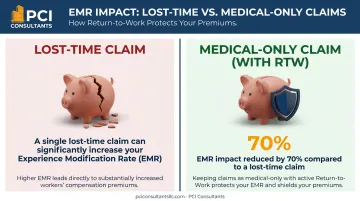
The moment an injury becomes a "lost-time" claim, its cost stops being about the medical bill and starts being about your premium. Lost-time claims drive up your EMR, the multiplier carriers use to price your workers' comp — and here is the part that stings: once that premium goes up after a claim, it rarely comes back down, even after the worker fully recovers and the file closes. You pay for a single bad claim for years. That is premium stickiness, and it is why prevention and containment beat cleanup every time.
For example, data from CPWR shows a single $50,000 construction claim can carry a total financial impact of $127,000 once indirect costs are counted, and can raise an EMR by 15 points — roughly $72,000 in extra premium over three years. These figures track with broader trends; the National Safety Council reports the average workers' compensation claim cost was $47,316 for accidents in 2022-2023.
The goal is to avoid lost-time status whenever it is medically appropriate. Claims that stay "medical-only" — the worker keeps earning wages — are discounted by 70% by the National Council on Compensation Insurance (NCCI) before they hit your EMR calculation. An RTW program is the single most effective tool for keeping a claim on the medical-only side of that line.
The "Lawyer Number" Problem
When a claim opens, the carrier sets a reserve — the amount it expects to pay. On a serious-looking construction injury that reserve can be set at, say, $250,000. But the actual medical spend on that same injury might land closer to $30,000, paid out incrementally at roughly $1,500 to $2,000 a month as treatment progresses — not as a lump sum, and not the quarter-million on the reserve sheet. Without an advocate watching the file, that inflated reserve tends to become the number your loss history is built on. Correcting reserves down to real cost is a core part of what active claims management does, and it directly protects the EMR that prices next year's premium.
The Skilled Labor Retention Advantage
In a tight trades labor market, your experienced crew is your most valuable asset. When an injured worker is sent home with no plan to return, they feel sidelined and undervalued — and they start taking recruiter calls. An RTW program keeps skilled tradespeople connected to the team and the work, which aids recovery and cuts turnover and rehiring costs.
Legal and Compliance Drivers
A formal RTW program shows a good-faith effort to provide reasonable accommodations for workers with medical restrictions, a key principle under the Americans with Disabilities Act (ADA). A documented process for offering modified or light-duty work gives you a defensible framework and strengthens your compliance position.
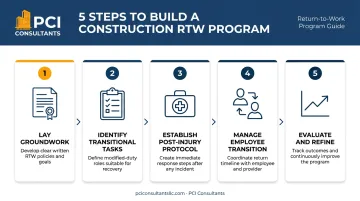
How to Build Your Construction Return-to-Work Program: A 5-Step Blueprint
A program only works if everyone — from the site super to the owner — understands it and supports it. Here is the build.
Step 1: Lay the Groundwork
Before anyone gets hurt, put the foundation in place.
- Develop a formal written policy stating your commitment, objectives, eligibility, and procedures for modified work.
- Designate an RTW Coordinator as the single point of contact for the worker, supervisors, medical providers, and — when you have direct claims handling — your brokerage rather than a call-center adjuster.
- Build a network of occupational medical providers who understand construction's physical demands and will write clear, specific work restrictions instead of a blanket "off work."
Step 2: Identify and Document Transitional Work Tasks
The hardest part in construction is finding meaningful work for someone with physical limits. Solve it before you need it. Brainstorm a "job bank" of valuable light-duty tasks so you can make a fast, appropriate written offer the day restrictions come in.
Examples of Transitional Duties on a Construction Site:
- Safety monitor or fire watch
- Tool crib attendant (check-in/check-out)
- Site access control and sign-in management
- Equipment and vehicle inspector (visual checks)
- Blueprint and safety-plan reviewer
- Delivery escort or materials spotter
- Light site cleanup within lifting restrictions
Write a formal description for each role with its physical requirements (e.g., "no lifting over 10 lbs," "seated 50% of the shift").
Step 3: Establish a Clear Same-Day Post-Injury Protocol
When an injury happens, speed protects both the worker and the claim. The first 24 hours create the medical record everything else is built on.
- Report immediately. The worker tells their supervisor the moment it happens.
- Get an accurate medical record the same day. Send the injured worker to urgent care or a designated occupational clinic right away. A timely, documented exam creates an accurate baseline — which is exactly what protects you later if the injury is exaggerated after the fact.
- Route the claim to your advocate. With direct claims handling, you call your brokerage, not the carrier's hotline. We evaluate the incident immediately and manage the file from there.
- Make the offer in writing. Once the doctor issues restrictions, the coordinator offers a suitable transitional-duty assignment in writing.
- Stay in contact. Keep supportive, regular contact so the worker feels like a valued crew member, not a case number — isolation is what pushes claims toward attorneys.
Step 4: Manage the Transition Back to Work
Bringing someone back on modified duty takes active management, not a form.
- Train supervisors on the RTW program's goals and on respecting medical restrictions — never pressuring a worker past their limits.
- Monitor progress with scheduled check-ins between the coordinator, the worker, and the supervisor, adjusting as medical updates come in. A nurse-style transition — moving an injured worker from full-duty labor to a receptionist-type or logistics role within weeks — is what sharply cuts real claim cost.
Step 5: Evaluate and Refine the Program
Track the numbers that prove it is working.
- Reduction in lost workdays per claim
- Percentage of claims kept "medical-only"
- Average claim duration
- Year-over-year EMR changes
Gather feedback from workers and supervisors and refine. Continuous improvement is what steadily lowers your EMR and controls insurance premiums. Individual results vary, but the direction is consistent when the program is run tightly.
What Active Claims Management Adds on Top of the Program
A written RTW policy is the framework. Who runs the claim is what determines the cost. This is where a hands-on brokerage changes the math.
We Handle the Claim Directly
For the life of the policy, when someone gets hurt you call us, not the insurer. We evaluate the incident immediately, get the worker the right care and the right documentation, and manage the file so it does not drift toward the carrier's default of paying face value and closing it. Because we are paid by commission from the insurer — not by how many claims you file or how much they cost — we are not incentivized to let a claim run. Our interest is the same as yours: keep the loss history clean.
Legitimate Injuries Paid, Exaggerated Ones Contested
Genuine injuries get paid promptly and without a fight — that is the deal, and it is the right thing. But when a claim is exaggerated or fraudulent, that same-day medical record from Step 3 becomes the evidence that lets us investigate and contest it instead of quietly paying it. Every dollar of inflated claim you stop is a dollar that never enters your loss runs to inflate future premium.
High-Deductible Programs for Qualifying Builders
For established construction companies with the balance sheet to support it, a high-deductible program can restructure the economics entirely. You take on a defined first layer of risk — say the first $200,000 of a $500,000 program — and the insurer covers the rest. That structure can roughly halve annual premium (for example, $100,000 down to $50,000), with claim payments made incrementally, around $3,000 a month, that stop when the condition resolves. It only works when the claims underneath are actively managed — which is exactly what we do — and not every business qualifies, so it is worth a real conversation before assuming it fits.
Right-Sizing Risk by Role
Not everyone on your payroll carries the same risk, and you should not pay as if they do. Segmenting your workforce by actual exposure — clerical and estimating staff versus hands-on trades — keeps you from overpaying premium on low-risk roles. For multi-entity builders, consolidating several operations under one owner into a single master policy can earn better terms than a stack of separate ones.
Adapting Your RTW Program for the Realities of Construction
A generic, one-size-fits-all program does not survive contact with a real jobsite. Adapt it.
Handling Multiple and Remote Job Sites
What if the worker's primary site is 100% heavy labor? Get creative with placement.
- Assign them to a central office or supply yard for inventory or logistics.
- Move them to a different, less physically demanding site.
- Assign remote tasks — reviewing safety modules, organizing project files — that can be done from home within restrictions.
Tailoring Tasks to Common Injury Types
Match the transitional work to the specific restriction.
- Back or sprain injuries: no-lift, no-twist tasks like monitoring cameras, checking safety equipment, or organizing blueprints.
- Hand or arm injuries: one-handed work such as safety spotting, hazard flagging, or managing sign-in sheets.
Working with Subcontractors
An injury to a sub's employee can ripple across a busy site. Communicate your RTW policy clearly, encourage subs to run similar programs, and confirm coverage up front — a general contractor's workers' comp exposure can widen fast when a sub's coverage is thin.
Common Mistakes That Derail Construction RTW Programs
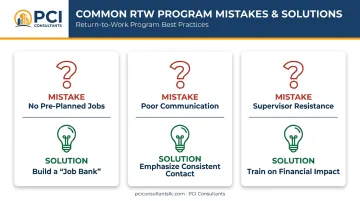
Mistake 1: No Pre-Planned Transitional Jobs
Inventing a light-duty role after an injury is a recipe for a task that is neither meaningful nor compliant with the doctor's restrictions. Build and maintain the job bank in advance so you can make a swift, formal, appropriate offer.
Mistake 2: Poor Communication
Leaving an injured worker in the dark breeds isolation and mistrust — the leading on-ramp to litigation. Consistent, supportive contact from the coordinator or supervisor keeps the worker connected and the claim on track.
Mistake 3: Supervisor Resistance
Some supervisors see a modified-duty worker as dead weight. That mindset sabotages the program. Train them on the math: keeping one claim medical-only can save tens of thousands in premium and protect the loss history for years. Frame supervisors as leaders in the company's risk strategy, not babysitters.
Conclusion: A Safer, More Profitable Construction Business
A proactive Return-to-Work program is one of the most powerful risk-management tools a builder has. A strong one rests on:
- A formal, documented policy
- Pre-identified transitional roles
- Clear, consistent communication
- Company-wide buy-in from ownership to the field
But the program is only half the equation — how the claim is handled is the other half. With over 30 years of experience, PCI Consultants handles claims directly, corrects inflated reserves down to real cost, keeps legitimate workers paid and moving back to work, and contests the claims that should be contested. To see where your current setup is leaking money, send us your current workers' comp policy and your five-year loss runs, and we will review your claims history and RTW program and tell you plainly what a tighter one would look like. Individual results vary.
Frequently Asked Questions
What are some examples of light-duty jobs on a construction site?
Common transitional roles include safety monitor or fire watch, tool crib attendant, site access and sign-in control, visual equipment inspection, and reviewing safety data sheets or plans in the site office. The key is having these documented in a job bank before an injury so you can make a written offer the day restrictions come in.
How does a return-to-work program actually reduce workers' comp premiums?
By keeping injuries "medical-only" instead of "lost-time." Medical-only claims are discounted 70% before they hit your EMR, and a lower EMR prices your premium down. Because premiums that rise after a lost-time claim rarely come all the way back down, keeping claims medical-only protects years of future cost, not just the current one.
If a worker looks seriously hurt, why not just let the insurer pay the claim?
Because a carrier's default is to pay a claim at or near its opening reserve and close it — and that reserve is often a padded "lawyer number" far above real cost. A $250,000 reserve can resolve as roughly $30,000 in actual medical spend paid incrementally over time. Managing the claim directly is how that gap gets corrected, which protects your loss history and future premium.
Should we send an injured construction worker to urgent care right away?
In most cases, yes. A prompt, documented medical exam on day one creates an accurate baseline of the actual injury. That record is what protects you if the injury is later exaggerated, and it lets legitimate claims be paid quickly while questionable ones can be properly investigated.
How do we manage an RTW program with subcontractors on site?
Communicate your RTW policy and expectations to every sub, encourage them to run similar programs, and verify their coverage up front. A general contractor's exposure can widen quickly when a subcontractor's workers' comp is thin, so coverage should be confirmed before work starts.
What if an injured worker refuses a suitable light-duty offer?
A refusal of a formal, doctor-approved light-duty offer can affect the worker's eligibility for wage-loss benefits, but the exact rules vary by state. Route it through your claims advocate so the offer is documented correctly and the right procedure is followed. Individual results vary.