A return-to-work (RTW) drug testing policy is the structured framework that governs what happens after an employee violates a drug or alcohol policy — or tests positive. It defines the conditions (evaluation, treatment, and a verified negative test) an employee must satisfy before resuming safety-sensitive duties.
At PCI Consultants we've spent 30-plus years watching this play out from the claims side, and here's the part that matters to your budget: a drug test isn't just a compliance box. Ordered at the right moment — the day of an incident — it becomes one of the most valuable pieces of the medical record that determines whether a claim gets paid at its real cost or its inflated "lawyer number." This guide covers when RTW testing is required, the step-by-step process, DOT vs. non-DOT obligations, what a written policy must include, and how these programs actually connect to workers' compensation costs.
Key Takeaways
- A verified positive test, a policy violation, or a refusal to test all trigger the RTW process
- DOT-covered employees must complete a SAP evaluation, treatment, and a directly observed return-to-duty (RTD) test before returning to duty
- Non-DOT employers — nursing homes, home health, hospitals, staffing — face no federal mandate for the full RTD process, but a written policy is essential for legal defensibility and for protecting your loss history
- A same-day post-incident drug screen and urgent-care visit build the accurate medical record that stops a genuine injury from being later exaggerated into a six-figure claim
- Several states offer workers' compensation premium discounts of 5–7.5% for certified drug-free workplace programs
- Incomplete documentation is what typically defeats employers in unemployment claims and litigation, not the policy itself
When Is Return-to-Work Drug Testing Required?
RTW drug testing is triggered by three distinct events. They carry identical consequences even though they arise differently.
Trigger 1: A Verified Positive Test Result
A positive lab result alone does not automatically trigger action. Under 49 CFR Part 40, Subpart G, a Medical Review Officer (MRO) must first review the laboratory-confirmed result and determine whether a legitimate medical explanation exists. Only after the MRO verifies the result as positive does the employer receive it and act.
This step matters legally. An employer who acts on an unverified lab result — before MRO review — creates significant exposure in any subsequent legal challenge.
Trigger 2: A Policy Violation Without a Positive Test
Not every RTW situation involves a drug test. Employees can trigger the same RTD obligations by:
- Possessing drugs or alcohol on company property
- Transporting controlled substances in a company vehicle
- Using alcohol while performing safety-sensitive duties
- Arriving for work visibly impaired
These violations carry the same RTD requirements as a confirmed positive test result.
Trigger 3: Refusal to Test
Refusing a lawfully ordered drug or alcohol test — whether random, post-incident, or reasonable suspicion — is treated as equivalent to a positive result. Under 49 CFR 382.211, this includes actions like leaving the collection site without authorization or failing to provide a sufficient specimen without a medical explanation.
Which Industries Face Federal Mandates?
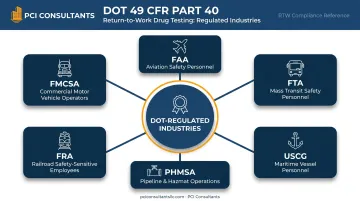
DOT regulations under 49 CFR Part 40 apply to safety-sensitive positions in federally regulated transportation, including:
- FMCSA — commercial truck and bus drivers
- FAA — aviation personnel
- FRA — railroad workers
- FTA — mass transit employees
- PHMSA — pipeline operations
- USCG — certain maritime workers
If you run a trucking operation, the process below is mandatory and unforgiving; we handle it inside a broader cost strategy for trucking companies. Non-DOT employers — and the large majority of the high-injury healthcare workforce we manage, from nursing homes to home health agencies, sits here — face no federal mandate for the full RTD process. But any organization with employees in high-risk or safety-sensitive roles should treat a written RTW drug testing policy as standard practice. It must also align with applicable state laws and the ADA.
The Step-by-Step Return-to-Work Drug Testing Process
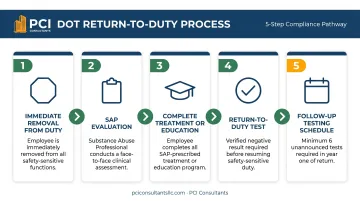
Step 1: Immediate Removal from Duty
Once a violation or verified positive result is confirmed, the employee must be removed from any safety-sensitive function immediately. For DOT-covered employees under 49 CFR 40.23, the employer must also report the violation to the FMCSA Drug and Alcohol Clearinghouse.
Allowing an employee to continue safety-sensitive work after a confirmed violation creates direct regulatory and liability exposure — no exceptions.
Step 2: SAP Evaluation
The employee must undergo a face-to-face assessment (in-person or via real-time audio/visual) with a qualified Substance Abuse Professional (SAP). Under 49 CFR 40.291, the SAP's role is to:
- Conduct a clinical evaluation
- Recommend a treatment or education plan
- Monitor the employee's progress through that plan
DOT employers must provide the employee with a list of qualified SAPs, including names, addresses, and phone numbers, as required by 49 CFR 40.287.
Step 3: Completing Treatment or Education
The employee must complete whatever program the SAP prescribes: inpatient treatment, outpatient counseling, or an education program. The SAP must confirm successful completion before the employee is cleared for an RTD test. Partial completion does not qualify — there is no interim clearance.
Step 4: The Return-to-Duty Drug Test
This test must produce a verified negative result before the employee may return to safety-sensitive work. Key thresholds:
- Controlled substances: Verified negative result
- Alcohol: Concentration below 0.02
For DOT employees, this collection must be conducted under direct observation by an individual of the same sex, as required under 49 CFR 40.67.
Passing this test does not require the employer to return the employee to duty. Under 49 CFR 40.305, reinstatement remains an employer personnel decision.
Step 5: Follow-Up Testing
The SAP prescribes a follow-up testing schedule once the employee clears the RTD test. Minimums for DOT-covered employees under 49 CFR 40.307:
- At least 6 unannounced, directly observed tests within the first 12 months
- SAP may extend requirements for up to 60 months
- Follow-up tests do not replace ongoing random testing obligations
Where the Drug Test Meets the Claim
Here's what the compliance guides leave out. A drug screen ordered as part of a post-incident protocol — the same day an injury happens — is worth far more than the same test ordered a week later. When a nurse reports a back injury lifting a resident, the way we run it is simple: evaluate the incident immediately and, where appropriate, send the worker straight to urgent care. That creates a timestamped, objective medical record on day one — including any post-incident screen — before anyone's story has a chance to grow.
That record is what protects you later. Genuine injuries get paid without a fight; that's the deal, and it's the right one. But when a claim starts drifting — a modest strain that becomes a permanent disability narrative once an attorney is involved — the day-one record is the anchor that keeps the claim tied to reality. Without an advocate handling the file this way, insurers tend to pay claims at or near face value and call it a "win." We treat that as the problem, not the outcome.
DOT vs. Non-DOT: Who Must Follow RTW Drug Testing Rules?
DOT Employer Obligations
For safety-sensitive positions in regulated industries, the RTD process is non-negotiable. Core requirements include:
- Mandatory SAP evaluation before any RTD test
- Direct observation for all RTD and follow-up urine collections
- FMCSA Clearinghouse reporting: violations and RTD results must be reported within the required window (negative RTD results within three business days of receipt)
- Minimum follow-up testing schedule of six unannounced tests in year one
Failure to comply with any element exposes the employer to DOT enforcement, civil liability, and the consequence of a safety-sensitive employee returning to duty without proper clearance. For employers outside federally regulated industries, the rules look different.
Non-DOT Employer Obligations
Non-DOT employers — which is most of healthcare — are not federally required to follow the full RTD process. In practice, several legal considerations still apply:
- The ADA applies. Employees currently engaged in illegal drug use are not protected, per EEOC guidance. But employees who have completed treatment or are in recovery may have protected status: the line between current use and past use determines coverage.
- State laws vary significantly. Drug testing statutes, marijuana protections, and workplace privacy laws differ across states. A policy legal in one state may create liability in another.
- No observation requirement. Direct observation during RTD collection is DOT-specific. Non-DOT employers have more flexibility in structuring collection procedures.
- No Clearinghouse obligation. FMCSA Clearinghouse reporting applies only to FMCSA-regulated employers.
Non-DOT employers who implement RTW drug testing should adopt a written, consistently applied policy. Inconsistent enforcement — applying the RTD process to some employees but not others in comparable situations — is one of the fastest routes to a discrimination claim, and it also weakens your position when you need to contest a questionable claim.
How to Build a Written Return-to-Work Drug Testing Policy
Why Written Policies Are Non-Negotiable
A written policy creates the legal foundation for everything else. Without it, an employer cannot defend termination, deny an unemployment claim, or enforce a last-chance agreement. Employees should sign a written acknowledgment of receipt — that signature is critical evidence if the policy is later disputed.
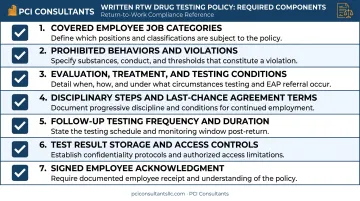
Per SAMHSA's drug-free workplace guidance, every effective written RTW drug testing policy should include:
- Which job categories are subject to testing (covered employees)
- Specific prohibited behaviors and what constitutes a violation
- Evaluation, treatment, and testing conditions required before return
- Disciplinary steps up to termination, including last-chance agreement terms
- Follow-up testing frequency and duration after return
- How test results are stored and who may access them
- Signed employee acknowledgment on file
Chain of Command and Enforcement
The policy must define who is authorized to remove an employee from duty, how SAP options are communicated, and who receives and maintains test results. These structural elements determine whether the policy holds up under scrutiny.
Consistency is essential. An employer that applies RTD procedures selectively — based on supervisor relationships, department, or any other variable — creates discrimination exposure. Key enforcement principles:
- Every covered employee in a comparable situation must be treated the same way
- Selective application based on department or supervisor relationships creates discrimination liability
- Documented chain of custody for all decisions protects the employer if challenged
This is also where the right classification of your workforce pays off. Your clerical and administrative staff don't belong under the same safety-sensitive testing regime as your hands-on caregivers or drivers — and they shouldn't be rated the same on your workers' comp policy either. Segmenting the workforce by actual risk keeps the low-risk roles out of programs and premium tiers they don't need.
Confidentiality and Documentation
Drug test results tied to alcohol testing are treated as medical records under EEOC guidance. Medical information from disability-related inquiries must be kept in a separate, confidential file. Standard illegal-drug tests are not medical examinations under the ADA, but applying the same confidentiality standard to all results is the defensible practice.
Documents to retain for every RTW case:
- Signed policy acknowledgment
- Chain of custody forms for all specimens
- Confirmation test results (GC/MS or LC/MS/MS methodology)
- SAP evaluation reports and treatment completion documentation
- Consent forms authorizing result disclosure to relevant parties
In unemployment claims, workers' comp disputes, and litigation, this documentation is what actually determines outcomes — not the policy language by itself. It's the same file that lets us pay the legitimate claim quickly and contest the exaggerated one credibly.
How Return-to-Work Drug Testing Affects Workers' Compensation Costs
The Substance Use and Claims Connection
The data on substance use and workplace injury is consistent: CDC/NIOSH reports that workers' compensation claims involving opioids were associated with temporary disabilities more than three times longer than comparable claims without opioids. Claim duration is one of the most direct drivers of WC premium — every additional week of lost time compounds into your experience modification factor over three subsequent policy years.
This is where the "lawyer number" problem lives. A claim can carry a $250,000 reserve on paper while the real medical spend is closer to $30,000 — and even that is typically paid incrementally, on the order of $1,500–$2,000 a month as treatment progresses, not handed over as a lump sum. Left unmanaged, the inflated figure is what drives your reserves, your loss runs, and your renewal. A drug-free workplace program plus disciplined claims management gives you a documented basis to keep the number honest where substance use is a contributing factor.
Faster Return to Work Is the Bigger Lever
Drug testing keeps impaired people out of safety-sensitive roles; return-to-work design is what keeps a claim from ballooning after an injury does happen. The single most effective cost control we deploy is a fast, structured light-duty transition. An injured nurse who can't yet lift patients can often handle a receptionist-type or intake role within weeks — which stops a medical-only claim from converting into an expensive lost-time claim and sharply cuts the real cost of the file. Pairing your drug testing protocol with a written light-duty return policy is where the two programs reinforce each other.
And it matters long after the claim closes, because premiums are sticky: once your rate rises after a bad claim year, it rarely comes all the way back down even after the claim resolves. That's a multi-year cost, which is exactly why the day-one record and the fast return matter more than any single settlement number.
State Premium Discounts for Certified Programs
Several states offer workers' compensation premium discounts to employers who maintain certified drug-free workplace programs:
| State | Discount |
|---|---|
| Georgia | 7.5% |
| Alabama | 5% |
| Arkansas | 5% |
| Florida | Up to 5% |
| Kentucky | 5% |
| South Carolina | 5% |
| Tennessee | 5% |
| Virginia | Up to 5% |
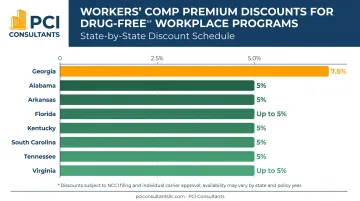
One important caveat: a 2020 NCCI review found that, in the NCCI states studied, policies with drug-free workplace credits did not consistently show lower claim frequency than comparable policies without them. The discount is a real benefit, but it isn't a substitute for actively managing your claims. Individual results vary.
The Broader Risk Management Picture
Drug-free workplace programs work best inside a broader WC cost-reduction strategy — not as a standalone policy exercise. For employers carrying six-figure WC premium, that means connecting RTW drug testing to claims management, fraud and exaggeration detection, and experience modification control.
A note on how we're paid, because it shapes everything above: PCI Consultants is compensated by commission from the insurer, not by your claims. We have no incentive to see a claim paid high — our whole job is to keep your real cost and your loss history down. For qualifying businesses (not every business qualifies), that can also mean structuring a high-deductible program — you take a defined first layer, say the first $200,000 of a $500,000 tower, the carrier covers the rest — which can roughly halve annual premium, with claim payments administered monthly and stopping when the condition resolves. You can read more on how large-deductible programs work.
The integrated approach — direct claims handling, day-one documentation, fast light-duty return, and program design tied to a measurable premium reduction strategy — is what moves employers off the default insurer path. Individual results vary, but the mechanics are the same every time.
Your Next Step
Want to know what your drug testing and return-to-work programs are actually doing to your workers' comp cost? Send us two things: a copy of your current WC policy and your five-year loss runs. That's all we need to review your loss history, spot the claims that were paid at face value when they shouldn't have been, and show you where an actively managed program would change the number. Reach PCI Consultants at 917-613-8580 or schedule a free 30-minute discovery call.
Frequently Asked Questions
What is a return-to-work drug test?
A return-to-work (or return-to-duty) drug test is a drug and/or alcohol test that an employee must pass with a verified negative result before resuming safety-sensitive duties after a confirmed positive test, a policy violation, or a refusal to test. Handled well, the surrounding documentation also becomes part of the medical record that protects your workers' comp claim costs.
Does a return-to-duty drug screen have to be observed?
For DOT-regulated employees, yes — the collection must be directly observed by someone of the same sex under 49 CFR 40.67. For non-DOT employers, such as most healthcare organizations, direct observation is not federally required, but it is strongly recommended to reduce the risk of specimen tampering.
Can you be rehired after failing a drug test?
It depends on the employer's policy. Some employers terminate after a positive test; others allow the employee to complete the RTD process and return under a last-chance agreement with follow-up testing. Neither federal law nor most state laws require employers to offer rehabilitation or reinstatement.
How long does the return-to-duty process take?
The timeline depends entirely on what the SAP prescribes. Some employees complete requirements in a few weeks through an education program; others with more intensive treatment needs may take several months before the SAP clears them for an RTD test. Individual results vary.
How does a drug testing policy actually lower my workers' comp costs?
Two ways. First, fewer impairment-related injuries and shorter claim durations mean less lost time feeding your experience modification factor. Second, a post-incident screen and same-day medical record give you a documented basis to pay genuine claims fairly while contesting exaggerated ones — which, combined with fast light-duty return, keeps claims from inflating to their "lawyer number." Certified programs may also earn a state premium credit where offered.
What happens if an employee fails a return-to-duty drug test?
A failed RTD test is a new violation: the SAP must be notified, and the entire process restarts. A second failure often results in permanent termination, and for DOT employees, it must be reported to the FMCSA Clearinghouse.