
This guide is written for both the injured employee who needs to understand their rights and the employer who is footing the bill and managing compliance obligations. We'll cover how the reimbursement process actually works, what's covered and what isn't, and the state-by-state rules that trip people up. Then we'll go one layer deeper than most guides and show you what the insurance company won't: how a small benefit like travel reimbursement fits into the bigger question of who is actually managing your claim, and how much that changes your cost.
Key Takeaways
- Workers' comp covers reasonable and necessary travel to and from approved medical care for a work injury, usually paid as per-mile mileage plus transit, parking, and tolls.
- Rates, forms, and deadlines are set state by state, so a mileage log that's fine in one state can be denied in another.
- For legitimate injuries, reimbursement should be paid promptly and without a fight. Padded mileage logs, on the other hand, are an early warning sign of a claim being inflated.
- Travel reimbursement is a symptom of a larger question: whether anyone is actively managing your claims, or whether the carrier is just paying at face value and calling it a win.
Understanding Workers' Comp Travel Reimbursement: The Basics
What Travel Reimbursement Is and Why It Exists
Workers' compensation travel reimbursement is a mandatory benefit that makes sure an employee's finances don't become a barrier to getting necessary medical treatment. When an injured worker travels to see a doctor, a physical therapist, or attend an Independent Medical Examination (IME), the employer's insurance is responsible for the reasonable cost of getting there.
This isn't a courtesy. In most states it's a statutory requirement, and the reason it exists is the same reason a good broker cares about it: getting the worker to treatment quickly and consistently is how you shorten the claim. The faster someone completes therapy and clears a return-to-work plan, the smaller the claim, and the less it weighs on your future premium. Removing the transportation hurdle is one small piece of keeping recovery on track.
The Part the Insurance Company Won't Emphasize
Here's what most travel-reimbursement guides skip. Left to its own devices, an insurer's default is to pay claims at or near face value and move on. Reviewing a mileage log line by line, questioning a taxi fare, or catching a padded round-trip number is friction they'd rather avoid, so they don't. A paid claim is a closed file, and a closed file counts as a win for the adjuster, even when it cost you far more than it should have.
That default is fine on the small stuff until you remember that every one of those dollars is cumulative. Travel reimbursement is minor on any single trip, but it's part of the total incurred cost on the claim, and total incurred cost is what your experience rating is built from. Overpay quietly for a year and it doesn't just cost you this year. It follows you.
A Step-by-Step Guide to Claiming Travel Reimbursement
The specific forms and deadlines differ by state, but the process follows a consistent pattern. Following these steps helps an injured worker avoid the common mistakes that cause delays.
Step 1: Understand Your State's Rules
Start with your state's Workers' Compensation Board website. Look for:
- The current mileage rate. It often changes annually and may be tied to the federal IRS standard mileage rate, but not always.
- The required form. Many states mandate a specific one, such as New York's Form C-257 or Ohio's Form C-60.
- Submission deadlines. States set different windows for filing expenses, so know yours before it closes.
Step 2: Document Every Expense
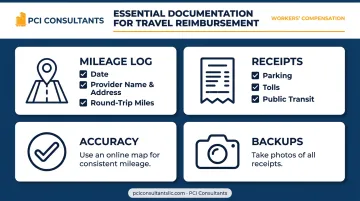
Documentation is the employee's responsibility, and incomplete records are the number-one reason payments stall. Keep a running travel log:
- Log all mileage. Record the date, the provider's name and address, your starting point, and the round-trip miles. A mapping tool keeps the numbers consistent and defensible.
- Save every receipt. Keep originals for public transit, ride-sharing, parking, and tolls. A phone photo is a good backup.
A clean, consistent log isn't just good hygiene for the employee. It's also exactly what a claims manager looks at first, because the log either lines up with the treatment schedule or it doesn't.
Step 3: Complete and Submit the Correct Forms
Fill out your state's required form completely. List each trip in order, total each one, and attach copies of every receipt. Before the packet goes to the carrier or its third-party administrator, make a full copy for your own records. That copy is your proof of what you sent and when.
Step 4: Follow Up and Address Disputes
After submission the carrier reviews the request. If there's no payment or response within a reasonable window (often 30 to 45 days), follow up with the adjuster. If the claim is partially or fully denied, the carrier must give a written reason. Sometimes it's just a missing receipt you can supply. If you disagree with the denial, you can formally dispute the decision through your state's workers' comp system.
This is also where having someone in your corner matters. When PCI Consultants manages a claim, the employer and the injured worker call us, not the insurer. We handle the back-and-forth on reimbursement and everything else directly, for the life of the policy, so a denied parking receipt doesn't turn into a standoff that drags the whole claim out.
What's Covered and What's Not: A Breakdown of Eligible Expenses
Reimbursement is limited to "reasonable and necessary" travel for authorized medical care. Knowing what qualifies keeps legitimate claims moving and keeps padded ones honest.
Commonly Reimbursed Expenses
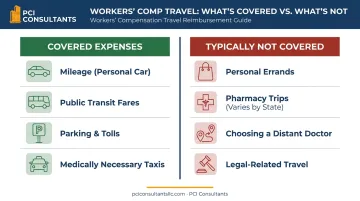
- Mileage. The most common reimbursement for using a personal vehicle, paid at a per-mile rate that varies by state. For example, the 2024 rate in New York is 67 cents per mile, and California's rate is also 67 cents per mile for 2024.
- Public transportation. Bus, subway, and train fares are typically covered. Receipts are almost always required.
- Taxis and ride-sharing. Covered when medically necessary, for instance if the injury prevents driving or using transit. Get pre-authorization from the carrier.
- Parking and tolls. The actual cost of parking at the facility and tolls on the direct route are reimbursable. Keep the receipts.
- Meals and lodging. Rarely covered, and usually only for pre-authorized long-distance travel, such as seeing a specialist in another city.
Common Exclusions and Gray Areas
- Personal errands. Combine a doctor's visit with a grocery run and you can only claim the direct medical round trip.
- Pharmacy trips. Varies by state. California explicitly covers them; others generally don't.
- A distant provider by choice. If an equivalent authorized provider is nearby but the worker picks one far away, the insurer may only reimburse to the local provider. Texas, for example, applies specific distance rules, covering trips over 30 miles one way in certain circumstances.
- Litigation travel. Costs of meeting an attorney or attending a hearing are not medical travel and are not covered here.
Travel Reimbursement and the Bigger Claims Picture
A few cents a mile won't sink a healthcare employer. But travel reimbursement is a useful window into a much larger reality, and it's worth understanding how the small piece connects to the big one.
The Mileage Log Is Often the First Sign of a Padded Claim
Genuine injuries should be paid without a fight, travel included. That's not just fair, it's smart, because fighting a legitimate claim only drags it out and raises the cost. But exaggerated claims usually show their hand early, and the mileage log is one of the earliest places. A worker logging daily round trips to a provider they're seeing twice a week, or claiming mileage on dates with no corresponding treatment, is a small tell that the same claim may be inflated in bigger ways.
This is the difference between paying a claim and managing one. Our approach is simple: pay the honest claims cleanly, and investigate the ones that don't add up. That same discipline applies whether we're looking at a mileage log or a disability claim, and it's the core of fraud and exaggeration prevention. Protecting your loss history on the exaggerated claims is what protects your premium down the line. Individual results vary, but the pattern is consistent.
The "Lawyer Number" Problem
Think about how the numbers get distorted. A claim gets described as a "$250,000 injury," a figure built for a demand letter. The real medical spend often turns out closer to $30,000, and it isn't paid as a lump sum. It's paid incrementally, frequently in the range of $1,500 to $2,000 a month, and it stops when the condition resolves. Travel reimbursement rides along inside that structure. An adjuster with no advocate on the other side tends to accept the inflated framing and pay against it. An active claims manager works from the real number.
Getting People Back to Work Shrinks the Whole Bill
The single biggest lever on a claim isn't the mileage rate. It's how fast the worker gets back to some form of work. In a nursing home, an injured nurse who can't do floor duty can often move to a receptionist-type light-duty role within weeks. That transition sharply cuts the real cost of the claim, and it also naturally winds down the travel reimbursement, because the treatment schedule tapers as recovery progresses. A structured light-duty return-to-work program does far more for your total cost than scrutinizing parking receipts ever will.
Why This Sticks to Your Premium for Years
Here's the part that makes the small numbers matter. Once a claim pushes your premium up, it rarely comes all the way back down, even after the claim closes. That stickiness is why quietly overpaying, on travel or anything else, is a multi-year cost, not a one-time one. Reducing the incurred cost of the claim while it's open is the only real window you have. Once it's baked into your experience rating, you live with it.
Best Practices and Common Pitfalls
A little proactivity goes a long way on both sides.
Tips for Injured Employees
- Submit regularly, monthly is a good rhythm, to keep cash flow steady and stay ahead of deadlines.
- Get pre-authorization for special transport or long-distance travel by calling the adjuster first. It prevents surprise denials.
- Keep clean records. An accurate, complete submission is the fastest path to getting paid.
Tips for Employers and Claims Managers
- Create a clear internal policy for how workers track and submit travel expenses, with the right forms and a single point of contact.
- Arrange transportation proactively when an inability to travel is causing missed appointments. A ride service that keeps treatment on schedule is almost always cheaper than the delay.
- Have someone actively managing the claim, not just paying it. For a healthcare operator with real claim volume, the administrative burden of state-by-state rules is only the surface. The deeper cost is the claims no one is scrutinizing. This is where active claims management changes the math, because the same firm handling your reimbursement questions is also correcting the inflated numbers, driving the return-to-work plan, and protecting your loss run.
If you own more than one facility, several nursing homes under one owner, for instance, consolidating them under a single master policy can also mean better terms and one consistent claims process across every location.
How PCI Consultants Handles This Differently
With 30-plus years placing and managing workers' comp for mid and large healthcare employers, we don't just quote a policy and disappear. We manage the claim directly for the life of the policy. When an incident happens, the employer calls us, and we evaluate it immediately, often sending the injured worker to urgent care right away to create an accurate, timely medical record. That record is what protects you against exaggeration later, and it's the foundation every downstream cost, travel reimbursement included, is measured against.
We're paid by commission from the insurer, not out of your claim payments, so we're not incentivized by your claims volume. That's the whole point: our job is to get you the smallest honest number, not the fastest closed file. For qualifying businesses, that can also mean structures like a high-deductible or large-deductible program, where you take on a defined first layer of risk in exchange for a materially lower premium, with claim payments administered monthly and stopped when the condition resolves. Not every business qualifies, but where it fits, it's one of the most effective ways to cut annual cost.
The concrete next step: send us a copy of your current workers' comp policy and your five-year loss runs. That's everything we need to review how your claims are being handled today, travel reimbursement and all, and show you where the cost is leaking. Individual results vary, but the review itself costs you nothing.
Frequently Asked Questions
What are the rules for travel expense reimbursement?
Employers must cover reasonable and necessary travel for an employee's approved medical care tied to a work injury. The forms, rates, and deadlines are set by state law, so check your state's workers' comp board. For legitimate injuries, that travel should be paid promptly and without a dispute. The scrutiny belongs on claims that don't add up, not on honest ones.
Can you travel when you are on workers' compensation?
For personal travel like a vacation, tell the insurance carrier first. It can affect your benefits if it interferes with scheduled treatment or conflicts with your work restrictions. If you're an employer and a worker's travel patterns don't match their claimed limitations, that's worth a closer look, and it's exactly the kind of thing an active claims manager watches for.
What is the mileage rate for workers' comp?
It varies by state and often changes each year. It's frequently tied to the federal IRS standard mileage rate, but not always. Confirm the current, official rate on your state's workers' comp board website, since that's the number your reimbursement will be paid against.
Do I need pre-authorization for travel expenses?
For standard mileage, usually no. For non-standard expenses like long-distance travel, airfare, lodging, or specialized transport, get pre-authorization first. Approval up front is the cleanest way to avoid a denial after the fact.
How long do I have to submit my reimbursement request?
Deadlines vary by state, often one or two years from the travel date. Submit promptly and regularly, monthly is ideal, so nothing slips past the statute of limitations. Check your state's specific rules to confirm the window.
Does travel reimbursement really affect my premium?
On its own, barely. But it's part of the total incurred cost on a claim, and total incurred cost drives your experience rating, which sets your premium for years. That's why the real issue isn't the mileage rate. It's whether anyone is actively managing the whole claim or just paying it at face value. Send us your current policy and five-year loss runs and we'll show you the difference; individual results vary.