Here's the part the insurance company won't tell you: when it comes to subcontractors, the audit is not a neutral fact-check. Left unmanaged, an auditor's default move is to sweep every dollar you can't document into your payroll, multiply it by your rate, and call it a win. Nobody at the carrier is arguing your side. That's the gap a working advocate closes.
This guide breaks down why subcontractors get scrutinized, exactly what documents protect you, the mistakes that quietly inflate your bill, and how active claims and risk management keep both your audit and your loss history from spiraling.
TL;DR
- A workers' comp audit reconciles the premium you estimated with what your actual payroll and operations say you owe.
- If you can't prove a subcontractor carried their own workers' comp, the auditor treats what you paid them as your payroll and charges you for it.
- The single most important document is a valid Certificate of Insurance (COI) for workers' comp from every sub, kept current for every day they work.
- A 1099 is a tax form. It offers zero protection in a workers' comp audit.
- The real exposure isn't just the audit bill — it's what happens when an uninsured sub's worker gets hurt and the claim lands on your policy, raising premiums that rarely come back down.
What Is a Workers' Comp Audit, and Why Do Subcontractors Complicate It?
A workers' compensation audit is an annual review by your insurance carrier that reconciles the estimated premium you paid at the start of the year with the actual premium your operations justify. The auditor looks at your payroll records, your job classifications (class codes), and how your business actually ran over the past twelve months.
So where do subcontractors fit? From the carrier's point of view, anyone working on your job — badged employee or not — could file a claim against your policy if they get hurt. The audit exists to make sure every one of those people was covered by some policy. If a sub you hired didn't carry their own workers' comp, that liability defaults to you. As carrier Travelers notes, a business "may be responsible for employees of uninsured independent contractors/subcontractors." The audit is built to find that uninsured exposure and bill you for it.
And this is where an unadvocated employer loses money by default. The auditor isn't paid to find reasons the charge shouldn't apply. Insurers, left to their own devices, resolve ambiguity in their own favor and move on — the same way they tend to pay a claim at or near face value and call it a win rather than work to minimize it. Someone has to push back with documentation and classification arguments. That's the job we do.
The Financial Impact: How Uninsured Subcontractors Inflate Your Premiums
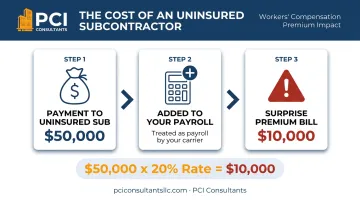
The math is brutal and direct. When an auditor finds payments to an uninsured subcontractor, they add that amount to your payroll for the audit period. As law firm Fisher Phillips explains, those fees are "treated as if those payments were payroll to your own employees," then multiplied by your rate.
Here's a simple example:
- A general contractor pays an uninsured roofing sub $50,000 over the year.
- The roofing class code carries a high rate — say $20 per $100 of payroll (a 20% rate).
- At audit, the $50,000 is added to the contractor's payroll.
- The result is a surprise premium of $10,000 ($50,000 × 0.20).
That charge applies even if the sub was a sole proprietor not legally required to carry coverage in your state. From the carrier's seat, the risk to your policy still existed, so they price it.
But the audit bill is only the visible half of the cost, and often not the worst half. The audit charge hits once, for a policy year that's already closed. The deeper exposure shows up if that uninsured roofer's worker actually gets hurt on your job. Now the claim runs through your policy — and a claim doesn't just cost what it costs. Once a loss hits your record, it feeds your experience rating and pushes your premium up, and here's the sticky part: once premiums rise after a claim, they rarely come back down, even years after the file is closed. A single uninsured-sub injury can quietly cost you across three or four renewal cycles. That's why we treat subcontractor documentation as loss-history protection, not paperwork.
When the Claim Becomes Yours: Why Active Management Matters
Most articles stop at "collect a COI." That's necessary, but it ignores what happens when prevention fails and an uninsured or under-documented sub's worker is injured on your site. At that moment the claim is effectively yours to manage — and how it's handled in the first 48 hours decides what it ultimately costs.
This is the core of how we work. When an incident happens, you call us — not the insurer. We evaluate it immediately and, where appropriate, get the injured worker to urgent care the same day. That early, accurate medical record is what protects you later against an exaggerated or drifting claim. It documents the real injury before it can quietly grow into something bigger on paper.
And claims almost always look bigger on paper than they are. A demand letter might frame an injury as a "$250,000 claim." Dig into the actual medical spend and it's frequently closer to $30,000 — and it isn't paid as one lump sum. Real workers' comp costs are paid incrementally, often on the order of $1,500 to $2,000 a month, and they stop when the worker recovers. We manage claims to that reality instead of the inflated headline number the insurer might otherwise pay at face value.
We also move recovery forward instead of letting a file sit open. Getting an injured worker into a light-duty role — an on-the-mend equipment operator moved to a materials or dispatch desk for a few weeks — sharply cuts the real cost of the claim and shortens how long it drags on your loss run. Legitimate injuries get paid without a fight. Exaggerated or fraudulent claims get investigated and contested. Individual results vary, but that discipline is what keeps a claim from turning into a multi-year premium tax.
The Essential Document Checklist to Protect Your Business
The only way to avoid the audit charge is to prove, in writing, that every subcontractor you paid carried valid workers' comp for the entire time they worked. Build the packet before anyone sets foot on the site.
Before Work Begins: Your Subcontractor Onboarding Packet
- Certificate of Insurance (COI) for Workers' Compensation. The most important document you collect. It should list your company as certificate holder, show active coverage spanning the project, and confirm a valid workers' comp policy — not just general liability.
- Written Subcontractor Agreement. A formal contract defining scope and payment terms, and stating clearly that the sub is an independent entity responsible for their own insurance and taxes.
- IRS Form W-9. Confirms the sub's legal business name and Taxpayer ID for year-end 1099-NEC reporting. Useful for records — but, to be clear, it proves nothing about insurance.
During and After the Project: Ongoing Record-Keeping
- Detailed Invoices. Require invoices that separate labor from materials. If an invoice shows only a lump total, an auditor may fold the entire amount — materials included — into your payroll.
- Proof of Payment. Keep cleared checks or transfer confirmations that tie directly to each invoice.
Risk Classification: Stop Overpaying Before the Audit Even Starts
Here's the flip side of the audit that carriers rarely volunteer: just as bad documentation can inflate your premium, sloppy classification can mean you're overpaying all year on workers who don't belong in a high-risk code. Your workforce isn't uniform. A project manager running estimates from a trailer is not carrying shingles up a ladder, and they shouldn't be rated as if they are.
We segment a workforce by actual risk — clerical and supervisory roles separated from hands-on high-risk trades — so you're not paying roofing rates on payroll that never touches a roof. Getting class codes and your experience rating right is one of the fastest ways to stop bleeding premium, and it makes the audit itself faster and less adversarial because your records already match reality.
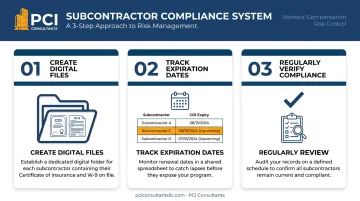
Audit prep isn't a last-minute scramble; it's a system you run from day one. Make the rule non-negotiable: no valid COI, no work, no payment. Then keep it clean:
- Keep a dedicated digital file for every sub with all required documents.
- Track COI expiration dates so coverage never lapses mid-project.
- Review the tracker on a schedule so nothing slips.
Managing class codes, subcontractor exposure, and loss history well is specialized work, and it's what we've done for 30-plus years. For qualifying businesses, an experienced advisor can also open up cost structures most brokers won't administer — high-deductible programs, for example, where you take on a defined first layer of risk (say the first $200K of a $500K program) and the carrier covers the rest. Done right, that can roughly halve annual premium — think $100K down toward $50K — with claims paid monthly (on the order of $3,000/mo) that stop when the condition resolves. It only works when someone actively administers those claims, and not every business qualifies. Worth noting: we're paid by commission from the insurer, not by your claims volume — so we have no reason to let a claim run up.
Common Mistakes and Misconceptions to Avoid
The same costly traps catch employers year after year.
Mistake 1: Relying on a 1099
The most common and expensive misconception. A 1099 is an IRS tax document, not an insurance document. Paying someone as a 1099 contractor does nothing to prove they carried their own coverage — and does nothing to protect you at audit. For the fuller picture, see why independent contractors are generally not covered under your policy.
Mistake 2: Accepting an "Opt-Out" or Waiver
In some states a sole proprietor or partner can legally exempt themselves from carrying workers' comp. That waiver does not stop your carrier from charging you a premium for the risk they still represent to your policy. A signed exemption is not a COI.
Mistake 3: Filing the COI and Forgetting It
A certificate collected at kickoff isn't enough. Policies get canceled for non-payment or simply expire mid-project. If a sub's coverage lapses — even for a week — every dollar you paid during that gap gets added to your payroll at audit. And if someone is injured during that gap, you own the claim, too.
What to Do Before Your Next Renewal or Audit
If you hire subs and you've never had your subcontractor exposure and class codes reviewed by someone whose job is to argue your side, you're almost certainly leaving money on the table — or sitting on a landmine. The concrete next step is simple: send us (1) a copy of your current workers' comp policy and (2) your five-year loss runs. That's everything we need to see where your audit risk sits, whether your workforce is misclassified, and whether a restructured or high-deductible program fits your situation. From there we take over the claims directly — you call us, not the insurer, for the life of the policy.
Frequently Asked Questions
Are workers' comp audits mandatory?
Yes. An audit is a standard, usually contractual condition of a workers' comp policy. It lets the carrier verify your payroll and operations and set the correct final premium for the period. It's not optional — but how much it costs you is heavily influenced by how well your records and classifications are prepared.
Does my workers' comp policy cover subcontractors?
Not automatically. But if a sub is uninsured and their worker is injured on your job, your policy is forced to respond — which means additional premium at audit and, worse, a claim on your loss history. That's why we treat subcontractor documentation as claims and premium protection, not just paperwork.
Who is accountable for the work of a subcontractor?
The sub is accountable for the quality of their work, but the hiring contractor is who the carrier holds accountable for making sure every sub is properly insured for workers' comp. If the proof isn't there, the cost lands on the general contractor — which is exactly what proper carrier selection and program design is meant to prevent.
How serious is a workers' comp audit?
Financially, very. Missing subcontractor documents can produce unexpected five- or six-figure bills for a year that's already closed. And an uninsured-sub injury can raise your premium for years, because increases from a claim rarely come back down once they land.
What is the most important document to collect from a subcontractor?
A valid Certificate of Insurance (COI) for workers' comp, kept current for every day the sub works. It's the only official proof that the sub carried their own active policy, and it's what keeps their payroll off your audit.
What if a subcontractor's insurance expires during the project?
You're responsible for collecting an updated COI before the old one lapses. Any payments you make during an uninsured gap get added to your premium at audit — and if a worker is hurt during that window, the claim runs through your policy. This is exactly the kind of gap a managed program is built to catch before it costs you.