This guide is written for the people who carry that cost, particularly in healthcare, where nursing homes, home health agencies, and hospitals sit at the top of the injury-risk chart. You'll learn how to prepare, what the consultant is actually looking at, and how to convert the findings into lower workers' compensation premiums instead of higher ones. Here's the part the insurance company won't volunteer: the inspection is only half the game. What you do with your claims and your class codes afterward is where the money is won or lost.
Key Takeaways
- A loss control inspection is a physical survey your insurer uses to assess workplace risk and verify the underwriting information behind your premium.
- Its stated goal is preventing future claims by finding and fixing hazards, which can lower your cost over time.
- The visit includes an interview, a document review, and a walkthrough of your facility.
- Preparation matters: gather your OSHA logs, safety programs, and training records, and have the right people available.
- The report's recommendations aren't optional. Documenting and closing them protects your coverage, and how your claims are handled after the visit is what really moves your premium.
What is a Loss Control Inspection?
A loss control inspection is a risk management service provided by your insurance company. A consultant evaluates your operations, property, and safety protocols to identify sources of loss, meaning the events that turn into claims. In a nursing home that might be resident-handling injuries, wet-floor slips, needlesticks, or repetitive-strain from lifting. It's meant to be a collaborative survey, not a punishment.
The consultant's job is to give both you and the insurer a clear picture of your real risk and a roadmap to reduce it before it produces an injury. That said, the report also feeds directly back into underwriting, so the way your operation looks on inspection day has a long tail.
It's worth separating this from an OSHA inspection. Both touch safety, but a loss control inspection exists for insurance underwriting and risk reduction, while an OSHA inspection is a regulatory action to enforce federal law. Failing OSHA can bring citations and penalties starting at $16,550 per serious violation. A loss control visit is about prevention and, handled right, about protecting your premium.
Why the Inspection Matters More Than You Think
A solid loss control program is one of the most effective ways to manage your workers' compensation cost. More than 60% of CFOs report that every $1 invested in injury prevention returns $2 or more. But the inspection matters for a reason most guides skip: it verifies the classification that determines your premium, and it shapes the loss history that follows you for years.
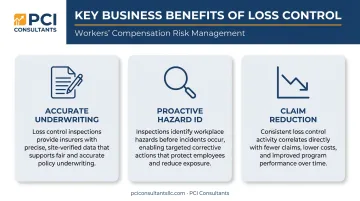
Accurate Risk Classification
The inspection verifies how your business and workforce are classified. This is where a lot of healthcare employers quietly overpay. A nursing home isn't one risk. Your floor nurses and CNAs doing resident transfers are high-risk, hands-on roles; your billing clerks, schedulers, and front-desk staff are low-risk clerical. If everyone is lumped into one high-risk code, you're paying floor-nurse rates on people who sit at a desk all day. Segmenting the workforce by actual risk, and making sure the inspection reflects it, is one of the cleanest ways to stop overpaying. This is a core piece of risk management for workers' comp.
Proactive Hazard Identification
An inspector is a fresh pair of eyes, catching risks your team walks past every day: a transfer done without a lift device, a cluttered med-room, poor ergonomics at nursing stations, blocked exits. According to the Liberty Mutual 2024 Workplace Safety Index, the top 10 causes of serious workplace injuries cost U.S. employers over $50 billion a year, and overexertion and falls, the everyday reality of patient care, sit near the top. Finding these before they become claims is the whole point.
Claim Reduction and Premium Stickiness
Fewer hazards mean fewer claims. A 2022 study found that on-site risk control consultations were associated with a 14% reduction in paid workers' compensation costs over the following two years. Fewer claims mean a lower experience modification rate (EMR), which flows straight into premium.
Here's the part that makes prevention worth the effort: premium stickiness. Once a serious claim pushes your premium up, it rarely comes all the way back down, even after the claim closes. You can pay for a single bad year for three or four renewal cycles. Preventing the claim, or minimizing its recorded cost, isn't a one-time saving. It's a multi-year one. Individual results vary, but the direction is consistent.
The Loss Control Inspection Process: Step by Step
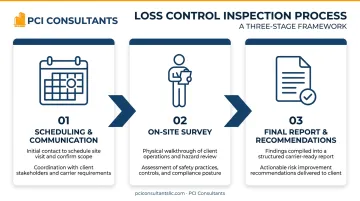
The inspection runs in three phases: before, during, and after. Knowing each one helps you get value out of it instead of just surviving it.
Step 1: Scheduling and Initial Communication
A consultant from your carrier (or a third-party firm they hire) contacts you to schedule the visit. It's usually triggered by one of three things:
- A new policy: the insurer wants to validate your application.
- Policy renewal: the visit confirms your risk profile hasn't drifted.
- A change in claims: a spike in frequency or severity, common after a rough year in a high-turnover facility, often prompts a look at the root cause.
The scheduler will ask for a main point of contact and coordinate around your operating schedule.
Step 2: The On-Site Survey
The visit has two parts: an interview and a walkthrough.
The Interview The consultant meets with key people, such as the administrator, DON, safety lead, or HR. Expect questions about:
- Safety programs and policies
- Hiring and new-employee orientation
- Task-specific training (safe patient handling, sharps, bloodborne pathogens)
- How you investigate and document incidents
- Your return-to-work program
That last item carries weight. An employer that can move an injured nurse into a light-duty, receptionist-type role within weeks looks materially lower-risk than one that lets people sit at home on full wage replacement.
The Walkthrough The consultant tours the facility and observes:
- Work habits: proper lifting and transfer technique, PPE use, lift-device availability.
- Equipment: guarding, maintenance, working ceiling and floor lifts.
- Fire and life safety: charged extinguishers, inspected sprinklers, clear exits.
- Housekeeping: dry floors, prompt spill cleanup, safe storage, clear corridors.
Step 3: The Final Report and Recommendations
Afterward, the consultant compiles a report summarizing strengths and flagging problems. The core is a prioritized list of recommendations, sorted by severity, from urgent hazards to advisable best practices. It's a concrete action plan, and, importantly, a document your underwriter will see.
How to Prepare for Your Loss Control Inspection
Treat the visit as a chance to sharpen your operation, not a test to cram for. Good preparation shows the consultant you run a disciplined shop.
Gather Key Documentation
Have these organized and ready:
- Written safety programs (Hazard Communication, safe patient handling, bloodborne pathogens, Emergency Action Plan)
- Training records, schedules, and sign-in sheets
- Equipment and lift-device maintenance logs
- Fire-protection inspection reports (sprinklers, alarms)
- OSHA 300, 300A, and 301 logs for the past three years
- Incident investigation reports
Identify Key Personnel
Make sure the right people can answer the consultant's questions. Your maintenance lead can speak to equipment and lifts, HR can cover hiring and training, and your administrator or DON can walk through clinical safety practices and how incidents get handled on day one.
Conduct a Self-Inspection
Walk the building a week or two ahead. Fix the obvious stuff: cluttered corridors, unmarked or blocked exits, dead emergency lights, expired extinguishers, a transfer being done without the lift. Closing these before the visit cuts the number of formal recommendations and signals initiative.
Prepare Your Questions
The consultant is a safety expert on a no-cost visit. If you're wrestling with resident-handling injuries or a specific loss trend, come with questions. That turns a compliance check into free expertise.
After the Inspection: Where the Money Is Actually Made
The report is a tool, and how you respond to it decides whether your premium goes up or holds.
Review, Prioritize, and Document
Recommendations come categorized by risk, often with deadlines. Build a corrective-action plan: assign each item to a person, set a firm date, and hit the most severe hazards first. As you close each one, document it with photos, invoices, and updated logs, and send proof to your insurance carrier by the deadline. Ignoring mandatory recommendations invites surcharges, non-renewal, or cancellation.
The Claim You Don't Manage Sets Your Premium
Here's what the inspection process alone won't fix, and what the insurance company won't tell you. Even with a clean report, one mishandled claim can undo years of safety work. When an injury happens and no one is advocating for the employer, the insurer's default is to pay the claim at or near face value and call it a win. It's not their money at stake the way it's yours, because your loss history and stuck premium carry the cost for years.
This is the difference between the "lawyer number" and the real number. A back injury gets framed as a $250,000 claim, but the actual medical spend might land closer to $30,000, paid incrementally at roughly $1,500 to $2,000 a month, not as a lump sum. Left unmanaged, the inflated figure is what lands on your loss runs and drives your renewal. Managed properly, the real, smaller number is what gets recorded.
That's why the moment of injury matters as much as the inspection. When a brokerage handles the claim directly, the incident is evaluated immediately, and the injured worker may be sent to urgent care right away to create an accurate, timely medical record. That record protects you against later exaggeration, and it lets genuine injuries get paid without a fight while exaggerated or fraudulent claims get investigated and contested. Combine that with a fast light-duty return-to-work transition, moving an injured nurse into a receptionist-type role within weeks, and the real cost of the claim drops sharply.
How PCI Consultants Fits In
With 30+ years in workers' comp, PCI Consultants doesn't just react to your carrier's report. We handle the claim directly for the life of the policy, meaning you call us, not the insurer, when someone gets hurt. We segment your workforce by real risk so clerical staff aren't priced like floor nurses, we push accurate day-one documentation, and we manage claims down to their true cost instead of letting them settle at the lawyer number. For qualifying businesses, we can also structure high-deductible programs, where you take on a defined first layer of loss and the insurer covers the rest, which can roughly halve annual premium; claim payments are then administered monthly and stop when the condition resolves. Not every business qualifies, and individual results vary. And because we're paid by commission from the insurer rather than by your claims volume, we're not incentivized by whether you have claims. We're incentivized to keep them small.
Common Misconceptions About Loss Control Inspections
Let's clear up a few myths that cause needless anxiety around loss control inspections.
Myth 1: "It's a surprise audit to catch us doing something wrong."
Reality: Inspections are almost always scheduled in advance. The goal is risk reduction, not punishment. Your insurer would rather prevent a claim than catch you out.
Myth 2: "A lot of recommendations means my premium goes up."
Reality: Premium is driven by your claims history and EMR, not the number of recommendations. Closing the consultant's suggestions signals you're serious about reducing risk, which helps prevent the claims that actually raise your rate.
Myth 3: "The consultant is looking for a reason to cancel us."
Reality: A large claim is expensive for the insurer too. The inspection is a tool to keep the relationship profitable by cutting the odds of a major loss, not an excuse to drop you.
Frequently Asked Questions
What is a workers' comp loss control inspection?
It's a physical survey by your insurer's consultant that assesses your workplace safety, employee practices, and operational hazards to find the risks that cause injuries and claims, and to verify that your business is classified correctly. In healthcare, that means looking closely at resident handling, sharps safety, and slip hazards. The aim is to fix problems before an accident happens and to make sure your premium reflects your real risk.
What are the types of loss control?
There are two. Loss prevention stops incidents from happening, such as ceiling lifts to eliminate manual transfers. Loss reduction limits the damage when something does happen, such as fire sprinklers or a fast return-to-work program that shrinks a claim's cost. A strong program uses both, and pairs them with active claims handling so the recorded cost stays close to the real cost.
What triggers a workers' comp audit?
An audit is different from an inspection. It's a mandatory financial review after your policy term ends to verify payroll and confirm you paid the correct premium. An inspection assesses physical risk; an audit checks the numbers. Getting your class codes right up front, so clerical and clinical staff are separated, keeps both from turning into an expensive surprise.
How long does a loss control inspection take?
It depends on your size and complexity. A single clinic may take an hour; a large facility with multiple units can run longer. Most on-site inspections land between one and three hours.
Can my insurance be canceled if I 'fail' an inspection?
It's rare, but an insurer can non-renew or cancel if you ignore critical recommendations. Documenting your corrective actions and sending proof by the deadline is the reliable way to avoid it. There's no such thing as a pass/fail grade, only whether you act on what's flagged.
Is a loss control inspection the same as an OSHA inspection?
No. A loss control inspection is a collaborative service from your insurer to help manage risk and set your premium. An OSHA inspection is a government regulatory action to enforce federal law, and it can result in fines and citations. One shapes your insurance cost; the other enforces the law.
Your Next Step
If you want to know whether your loss control inspection is helping your premium or quietly working against you, the fastest way to find out is a review. Send us a copy of your current workers' comp policy and your five-year loss runs. We'll read your class codes, your loss history, and any open recommendations, and tell you where you're overpaying and what we'd fix first. Individual results vary, but the review costs you nothing but the paperwork. Start with a no-cost workers' comp consultation.