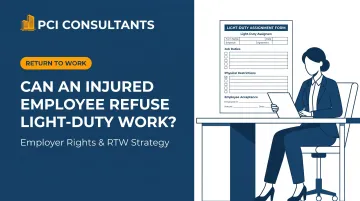
If you run a nursing home, home health agency, or hospital, you already know this scene. A back or shoulder injury on a resident transfer, the treating doctor releases the worker to modified duty within weeks, and the employee refuses to come back. Handled well, that claim resolves at a few thousand dollars. Handled by default, it converts into a lost-time claim that follows your loss history for three policy years and quietly raises your premium at every renewal after that.
Here is what the insurance company won't tell you: left to their own devices, most carriers will keep paying the temporary disability check and call the file "managed." They are not incentivized to force the light-duty conversation. We are. This article covers when refusal is legally protected, when it isn't, and — more importantly — how an actively managed return-to-work program turns a light-duty policy from a paper document into real dollars off your claim cost.
Important note: Workers' compensation rules vary significantly by state, and individual results vary. Nothing here is legal advice — consult a licensed workers' comp professional for guidance specific to your jurisdiction.
Key Takeaways
- Refusing a valid, physician-approved light-duty offer typically suspends or reduces temporary disability wage benefits — but the offer has to be built correctly first.
- A valid light-duty offer must fall within documented medical restrictions, be made in writing, and be at a comparable, accessible work location.
- A fast, well-documented light-duty transition (an injured nurse moved to a receptionist-type role within weeks) is one of the single biggest levers on real claim cost.
- The difference between a "$250,000 claim" and a ~$30,000 claim is usually early medical documentation plus an early return to work — not luck.
- Once a lost-time claim raises your premium, that increase rarely comes back down after the claim closes. Preventing the conversion is the whole game.
What Is Light-Duty Work in Workers' Compensation?
Light-duty work is a temporary, modified assignment given to an injured employee whose treating physician has cleared them for limited tasks. In a healthcare setting it usually means:
- Reduced physical demands — no resident lifting, transfers, or repetitive bending
- Restricted hours or a modified schedule
- A different role than the pre-injury position: an injured floor nurse covering the front desk, handling intake calls, chart auditing, or new-hire training
The treating physician defines exactly what the employee can and cannot do, and those written restrictions are the controlling document. Any assignment has to fall inside what the physician approved on paper — not what a scheduler thinks is reasonable, and not a supervisor's informal read of the situation.
States formalize this differently, but the physician's authority is consistent:
- Texas: The DWC Form-073 (Work Status Report) captures return-to-work status, lifting limits, driving eligibility, and medication restrictions.
- California: The DWC requires the treating doctor to document work restrictions in a medical report, and assigned work must meet those restrictions.
- All other states: The physician's written restrictions still define the legal boundary of any valid light-duty offer.
Here is where an active broker earns its keep versus a carrier that files and forgets. When one of our clients has an incident, we evaluate it immediately and, when appropriate, send the worker to urgent care that day. That early, accurate medical record does two things: it gets a legitimate injury treated fast, and it establishes a documented baseline so the restrictions — and any later attempt to exaggerate them — are measured against something real. A clean day-one record is what makes a light-duty offer defensible three months later.
Can an Injured Employee Legally Refuse Light-Duty Work?
The General Rule
In most states, an injured employee cannot refuse a legitimate, physician-approved light-duty offer without risking their wage benefits. The workers' comp system replaces lost wages — if suitable work is genuinely available within the restrictions, the justification for wage replacement weakens.
Florida Statutes § 440.15 says plainly that an injured employee who refuses employment suitable to their capacity forfeits compensation for the period of refusal — unless the refusal is justifiable. Others follow the same logic:
- Tennessee: Failure to report for employer-offered light duty may terminate temporary disability benefits.
- Texas (TDI): Refusing a bona fide offer may cause loss of Temporary Income Benefits.
- New York: Partially disabled claimants who decline suitable work risk suspension of reduced earnings benefits.
That financial consequence only applies when the offer itself meets specific legal standards — which is exactly why the offer has to be engineered, not improvised.
What Makes a Light-Duty Offer "Legitimate"
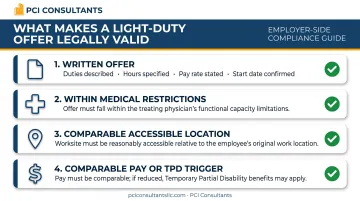
Not every offer qualifies. A valid one must generally:
- Be made in writing, with specific duties, hours, pay rate, and start date
- Fall within the medical restrictions documented by the treating physician
- Be at a comparable, accessible location
- Offer pay close to the pre-injury wage, or trigger partial disability benefits for the difference
Texas gives the most explicit checklist under 28 TAC § 129.6: a written bona fide offer stating location, schedule, wages, physical and time requirements, and a copy of the Work Status Report. It also requires geographic accessibility — accounting for the worker's limits on travel and transportation. Even outside Texas, that framework is a practical standard for what a defensible offer looks like.
This is the discipline our return-to-work program is built around. We don't hand you a template and wish you luck; our claims team drafts the written offer, routes it to the treating physician for sign-off, and documents the whole chain — because a valid offer on the table is the prerequisite for every downstream cost saving.
The "Voluntary Unemployment" Concept
When an employee refuses suitable work, many states treat it as voluntarily leaving the labor market. New York frames this through "labor market attachment": partially disabled claimants who aren't working must show they're actively seeking work within their medical restrictions. Refusing available suitable work — or not looking — can suspend reduced earnings benefits.
The practical implication for employers is large. A well-documented, properly structured offer shifts the burden back to the employee: decline without a justifiable reason and benefits stop. But if the offer is flawed — wrong duties, inaccessible location, undocumented — the refusal is protected and you've gained nothing.
When Is Refusing Light-Duty Work Justified?
Not every refusal is a problem. Several circumstances give workers valid grounds — and a good broker will tell you the difference honestly rather than picking a fight over a legitimate injury.
The Offered Duties Exceed Medical Restrictions
If the light-duty role requires lifting, standing, or anything the physician explicitly restricted, the employee can decline. California's DWC FAQ confirms it: work that doesn't meet treating-doctor restrictions doesn't have to be accepted. Employees in this position should refuse in writing, cite the specific restriction violated, and notify the physician immediately.
The Physician Hasn't Cleared the Employee for Any Work
If the treating doctor hasn't released the employee to any work capacity, the offer is premature and refusal shouldn't affect benefits. The medical precondition simply hasn't been met.
The Role Is Unsuitable in Other Ways
Boards evaluate whether work is genuinely "suitable," which can include worksite conditions that aggravate the specific injury, unreasonable travel, or role requirements fundamentally incompatible with the documented limitations.
Where We Push Back — and Where We Don't
This is the part carriers get lazy about. A genuine injury gets paid without dispute — full stop. But an exaggerated or fraudulent refusal is a different animal. When a worker cleared for a receptionist-style role suddenly can't sit at a desk, that pattern gets investigated, not rubber-stamped. That's the reasoning behind an inflated "lawyer number": a claim positioned as $250,000 that, with an accurate medical record and a real light-duty offer, resolves closer to $30,000 in actual medical spend — paid incrementally, typically around $1,500–$2,000 a month, not as a lump sum. Contesting exaggeration protects your loss history and your future premiums. Our approach to fraud and exaggeration screening is simple: pay what's real, question what isn't.
Consequences of Refusing Light-Duty Work
Loss of Wage Benefits
When an employee refuses a valid offer, the insurer or employer can file to suspend or reduce temporary total disability (TTD) or temporary partial disability (TPD) benefits. The employee is typically notified first, and procedural errors can undo the suspension — one more reason this shouldn't be run by whoever happens to answer the phone that day.
How TPD Works When Light-Duty Pay Is Lower
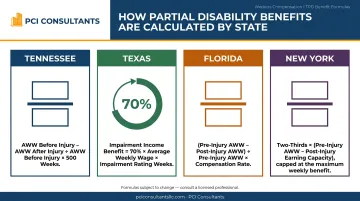
If an employee returns to light duty at reduced wages, partial disability benefits typically cover a portion of the difference. Formulas vary by state:
| State | TPD Formula |
|---|---|
| Tennessee | 66⅔% of the difference between AWW and light-duty wages |
| Texas | Generally 70% of the difference (75% for lower-wage workers in first 26 weeks) |
| Florida | 80% of the difference between 80% of AWW and gross earnings |
| New York | Up to two-thirds of the difference between pre- and post-injury wages |
Example (Tennessee): A CNA earning $1,000/week pre-injury takes a light-duty front-desk role at $600/week. The $400 gap yields roughly $267/week in TPD (66⅔% of $400), bringing weekly income to about $867. Note what happened to your claim: instead of paying full indemnity while she sits home, you're paying a wage differential while she's productive on your floor — and the clock on the claim is running down, not up.
Employment Status and Credibility
Workers' comp laws prohibit retaliation for filing a claim. Repeated refusal of a legitimate offer without medical justification is a different matter and can create employment-law exposure under general insubordination standards, depending on the state. Just as important, that pattern damages the worker's credibility at any hearing or settlement — judges and insurers read it as bad-faith non-cooperation with recovery.
What Employers Should Do When an Employee Refuses Light Duty
Make the Offer in Writing — Every Time
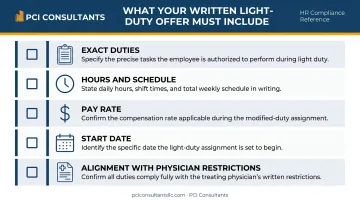
The written offer is the foundation of any refusal consequence. It must specify exact duties, hours and schedule, pay rate, start date, and how the role aligns with the physician's documented restrictions. Without that detail in writing, your ability to request a benefit suspension is compromised.
Get Physician Sign-Off Before the Offer Is Made
Send a written job description to the treating physician and get documented confirmation that the duties fall inside the restrictions. California's Labor Code § 4658.7 explicitly requires physician evaluation of whether job requirements are compatible with work restrictions — good practice in every state.
Coordinate Benefits Changes Through Proper Channels
Consult your WC advocate before suspending benefits. Each state has procedural requirements for how and when suspension requests are filed, and skipping a required notice step can unravel an otherwise airtight case. With our clients this isn't the employer's job to figure out — the claim call comes to us, and we run the suspension the right way.
Don't Let Refusals Go Unmanaged
This is where money is won or lost. When a light-duty refusal isn't caught and acted on quickly, a medical-only claim converts into a lost-time claim — and that carries far more weight on your experience rating for the next three policy years. And here's the part that stings: once that lost-time claim pushes your premium up, it rarely comes back down after the claim closes. You're paying for one mishandled refusal for years.
Because we handle the claim directly — you call us, not the insurer — we catch return-to-work refusal patterns early and keep them from becoming extended lost-time files. Across healthcare especially (nursing homes, home health, assisted living), we help clients maintain a documented, medically appropriate light-duty bank — front desk, intake, scheduling, chart review, new-hire training — so a valid offer is ready the moment the physician releases the worker. For a multi-location operator, we can consolidate several facilities under one master policy and administer return-to-work consistently across all of them. This is active claims management, not a certificate in a drawer.

Frequently Asked Questions
Does an employer have to accommodate light duty?
You're generally not required to invent a light-duty position that doesn't exist. But if suitable work is available within the medical restrictions, offering it is both best practice and, in most states, the thing that affects the employee's wage-benefit eligibility if they refuse. The practical move is to build a standing light-duty job bank ahead of time so you're never scrambling to create a role after an injury.
What is a standard return-to-work policy?
A solid policy covers three things: how light-duty offers are documented and delivered, who owns communication with the treating physician, and the timeline for transitioning back to full duty. The offer must align with the physician's written restrictions or the employee has grounds to decline. If you want a model to work from, our overview of return-to-work policies walks through the structure.
Can my employer refuse to let me return to work after surgery?
Employers can require physician clearance and a fitness-for-duty exam before a return. Blocking a return after the treating physician has cleared the worker, though, can create liability under state WC statutes or federal disability law, including the ADA if the condition qualifies.
What happens to workers' comp benefits if an employee refuses light duty?
In most states, refusing a valid, physician-approved offer can suspend or reduce temporary disability wage benefits — because if suitable work is available, the lost-wage justification weakens. The financial upside for the employer isn't a penalty on the worker; it's getting a productive employee back and stopping the claim from ballooning. Individual results vary by state and by claim.
Can an employee be fired for refusing light-duty work?
Retaliation for filing a claim is prohibited, but repeatedly refusing a legitimate offer without medical justification can expose the employee to standard employment-law consequences, depending on the state and your policies. Document everything before you act.
How does light duty actually lower my workers' comp cost?
Two ways. First, it keeps a medical-only claim from converting to a lost-time claim, which is what drives up your experience rating. Second, real claim payments are typically structured incrementally — often a few thousand dollars a month — and stop once the condition resolves and the worker is back, rather than accruing full indemnity while someone sits at home. The faster the legitimate return, the smaller the real number. Individual results vary.
Ready to Turn Your Light-Duty Policy Into Real Savings?
A light-duty policy is only worth what it saves, and it only saves when someone actively works the claim. If you're a healthcare employer with 100+ employees and a six-figure comp spend, send us two things: a copy of your current workers' comp policy and your five-year loss runs. We'll review how your recent claims were handled, show you where lost-time conversions and inflated "lawyer numbers" cost you, and lay out what active claims management would look like for your facilities. No obligation — just a straight read on your numbers.