This guide is written for healthcare employers, HR managers, and risk managers, the operators running nursing homes, home health agencies, and hospitals where injury frequency is highest. We'll cover exactly what a PI can and cannot legally do, the full investigation process, when surveillance is worth the money, and why active claims management catches most exaggeration long before a PI ever becomes necessary.
Key Takeaways
- A workers' comp investigation is a legal process to gather objective evidence on a suspicious claim, often through surveillance.
- Employers use PIs to verify injuries, document activities that contradict claimed limitations, and deter fraud, all to protect loss history and premiums.
- The process runs from a good-faith predicate through surveillance, reporting, and a documented chain of custody.
- Strict legal limits apply: a PI can observe in public but cannot trespass, wiretap, plant a GPS tracker, or harass a claimant.
- A PI is a late, expensive tool. Genuine claims should be paid fast; the real leverage is a day-one medical record and hands-on claims handling that flags exaggeration early.
What Is a Workers' Comp Private Investigation?
A workers' comp private investigation is a formal inquiry by a licensed professional to gather evidence about an injury claim. The goal is to verify whether a claimant's real-world activity matches their claimed physical limitations, producing objective evidence to support or contest the claim.
That's different from an internal HR review, which focuses on workplace interviews and policy compliance. A PI investigation centers on external surveillance and public-record evidence gathered outside the workplace. It's also different from the everyday work of catching exaggeration, which starts the moment the incident is reported, not weeks later when a claim has already ballooned.
Here's the distinction that matters most: a legitimate injury and an exaggerated one are handled very differently. A nurse with a real rotator cuff tear should be paid without a fight. The problem is the claim that starts as a genuine strain and gets inflated, or the "$250,000 claim" that, on the actual medical record, is closer to $30,000 of real treatment paid incrementally at roughly $1,500 to $2,000 a month. A PI is one way to test the gap. A better-run claim often closes it before it opens.
Why Employers Use Private Investigators for Workers' Comp Claims
The decision to hire a PI is almost always about cost control. Most claims are legitimate, but exaggerated and fraudulent ones create a real financial burden, contributing to an estimated $9 billion in losses annually, according to the Coalition Against Insurance Fraud Task Force. And the damage isn't a one-time hit: once a claim drives your premium up, it rarely comes back down, even after the claim resolves. You can be paying for an exaggerated back injury for years.
Here's why that matters more than most employers realize. Left to their own devices, insurers tend to pay a claim at or near its face value and call it a "win." They have little incentive to fight over the difference between a $250,000 demand and $30,000 of real cost, because it isn't their premium on the line next renewal, it's yours. That's the vacuum a PI, or a real claims advocate, is meant to fill.
The common business drivers for bringing in a professional fraud investigator:
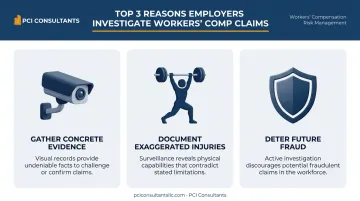
- Concrete evidence of fraud. A CNA collecting total-disability benefits while working a second physically demanding job is nearly impossible to prove without video. A PI can obtain it.
- Documenting exaggerated injuries. A claimant reporting a disabling back injury filmed lifting furniture or doing heavy yard work gives you objective grounds to dispute the severity of the claim.
- Deterring the next false claim. When staff know exaggerated claims get scrutinized, and legitimate ones get paid promptly, frivolous filings drop.
The Workers' Comp Investigation Process: A Step-by-Step Guide for Employers
When you suspect a claim is exaggerated, a professional investigation follows a strict, methodical process so the evidence holds up. Here's what to expect.
Step 1: Initial Case Assessment and Predicate
Before any surveillance, you need a "good faith" reason to investigate, a predicate. A hunch is not enough and invites harassment claims. Strong predicates are built on objective red flags:
- An anonymous tip from a coworker.
- An injury with no witnesses.
- A claim filed right after discipline or termination.
- A claimant who is unreachable or repeatedly misses medical appointments.
- A reported injury inconsistent with the incident described.
This is exactly where day-one handling pays off. When our team evaluates an incident immediately and, where warranted, sends the worker to urgent care the same day, you get an accurate, timely medical record. That record is your predicate baseline: it's far easier to spot later exaggeration when the original injury was documented properly instead of reconstructed weeks after the fact.
Step 2: Choosing a Reputable Investigator and Defining Scope
Not all PIs are equal. Select one who is licensed, fully insured, and experienced specifically with workers' comp cases. Together you'll define clear objectives, set a budget, and agree on scope before anyone starts filming.
Step 3: Evidence Gathering and Surveillance
This is the core of the work, and every method must stay inside legal bounds.
- Public records searches: criminal records, business ownership, and other relevant public information.
- Social media monitoring: reviewing the claimant's public profiles for posts or videos that contradict claimed limitations.
- Physical surveillance: discreetly observing and recording the claimant in public areas where there's no reasonable expectation of privacy.
Step 4: Analysis and Reporting
After surveillance, the investigator compiles a detailed, unbiased report, dates, times, a chronological activity log, and any supporting photo or video. It presents facts, not opinion.
Step 5: Using the Evidence
The report goes to your claims manager, legal counsel, or carrier. It then informs the real decisions: contesting an exaggerated claim, adjusting benefits to documented ability, or negotiating a fair resolution. This is also where the medical record and the surveillance meet, and where an inflated "lawyer number" gets corrected down to what the injury actually costs.
Legal Rules and Boundaries: What Your PI Can and Cannot Do
The line between lawful surveillance and illegal harassment is sharp. A reputable investigator never crosses it, because doing so triggers lawsuits and gets the evidence thrown out.
Permissible Investigation Tactics
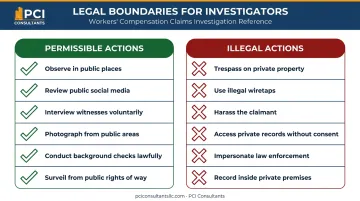
- Surveillance in public places. A PI can observe and record in any space open to the public, a front yard visible from the street, a store parking lot, a park, a restaurant.
- Photo and video in public. Where there's no reasonable expectation of privacy, recording is generally permitted.
- Reviewing public online activity. Anything posted publicly on Facebook, Instagram, or TikTok is fair to review.
Actions That Cross the Legal Line
- Trespass on private property. No entering a home, enclosed backyard, or garage without permission, no peeking through windows, no climbing fences.
- Illegal surveillance methods. No wiretapping, no hacking accounts, no GPS tracker on a vehicle. Tracking laws vary by state but are frequently prohibited or legally high-risk.
- Harassing the claimant or family. No threats, no aggressive tailing, no repeated confrontation, and never impersonating law enforcement.
When Hiring a PI Is Not the Right Move
Surveillance is a targeted, expensive tool, not a default response to every claim. Deploy it without a strategy and you waste money and create new liabilities.
Situations where a PI is likely the wrong move:
- Low-value claims. Surveillance runs roughly $85 to $150 per hour, and a typical case climbs into the thousands fast. If the investigation costs more than it could save, it's a bad trade.
- No objective predicate. A "fishing expedition" on a manager's gut feeling damages morale and exposes you to harassment or retaliation claims if nothing turns up.
- As a first resort instead of proper claims management. A PI is reactive. The bigger savings come from handling the claim well from hour one.
This is the part the default insurer relationship glosses over. Most exaggeration is caught, and defused, without a camera. When you call us directly instead of the insurer, we evaluate the incident immediately, build an accurate medical record, and pay legitimate injuries without dispute while contesting the ones that don't hold up. We also move injured staff into light duty quickly, an injured nurse into a receptionist-type role within weeks, which cuts the real cost of the claim and shrinks the window for exaggeration. Our return-to-work program and medical management do more to protect your loss history than surveillance usually can.
And our incentive is aligned with yours: we're paid by commission from the insurer, not by how many claims you have, so we have no reason to rubber-stamp an inflated number. Genuine results vary case to case, but the pattern is consistent, active handling beats late investigation.
Want the deeper playbook on catching bad claims early? See our guide on preventing fraudulent workers' comp claims and on disputing a claim as an employer.
Frequently Asked Questions
Is surveillance evidence admissible in a workers' comp hearing?
Generally, yes, if it was obtained legally. Evidence gathered without trespassing or violating privacy laws, reported factually without bias, and supported by a clear, documented chain of custody can be used in a hearing. Evidence obtained illegally, through trespass, wiretapping, or hacking, is typically thrown out and can expose you to liability. Individual results vary by state and by the facts of the case.
What are the risks of a poorly conducted investigation?
A sloppy investigation can trigger invasion-of-privacy lawsuits, harassment or retaliation claims, and dismissal of all collected evidence. That leaves you worse off than if you'd never investigated: no usable proof, higher legal exposure, and a claim you now have less standing to contest.
How much does a workers' comp private investigator cost?
Expect roughly $85 to $150 per hour, with a typical multi-day case running into the thousands. Because it's expensive, a PI only makes financial sense on high-value or highly suspicious claims where you have a solid predicate. For most claims, active handling and a day-one medical record protect you at a fraction of the cost.
Can a PI legally check an employee's social media?
Yes, but only what's public. A licensed investigator can review posts, photos, and videos on public profiles, and a claimant filmed doing what they claim they can't do is powerful evidence. What a PI cannot do is hack a private account, use a fake profile to gain access, or otherwise defeat privacy settings.
Should we hire a PI or just have our carrier handle it?
Here's the catch: left alone, a carrier often pays a claim near face value and moves on, because the premium hit lands on you, not them, and it rarely comes back down once it rises. An advocate who handles claims directly, and knows when a PI is genuinely warranted, is what closes the gap between a $250,000 demand and the roughly $30,000 a claim like that actually costs.
What's the alternative to hiring a private investigator?
Active claims management. Evaluate every incident immediately, create an accurate medical record the same day (urgent care when warranted), pay legitimate injuries without dispute, contest exaggerated ones, and move staff into light duty fast. This catches most exaggeration early and protects the loss history that drives your premium, making a PI unnecessary in many cases. To have us review yours, send your current workers' comp policy and five-year loss runs.