Introduction
"Return to work" means two very different things in 2026, and if you run a nursing home, home health agency, or hospital, both land on your desk at once.
For an employer with an injured caregiver, a return-to-work (RTW) policy is a formal, structured process tied to workers' compensation, ADA compliance, and — the part the insurance company won't emphasize — the real dollar cost of the claim. For an employer managing office and administrative staff, "return to work" means office re-entry mandates and the retention friction that follows.
The stakes are different, but the pattern is the same: without a deliberate policy and someone actively working the claim, costs compound fast. According to the NSC's Injury Facts data, the average lost-time workers' compensation claim runs $47,316 — and that figure climbs when nobody is moving the injured worker back to productive duty. On the office side, Gartner found that 33% of executives given an RTO mandate planned to leave.
At PCI Consultants, we've spent 30+ years on the injury side of that equation — placing and actively managing workers' comp for healthcare employers, and handling the claim directly so the return-to-work process actually happens instead of sitting in a file. This guide covers both contexts, but it goes one layer deeper than the usual HR checklist on the part that costs you real money: getting an injured employee back to work.
Key Takeaways
- RTW (injury/illness) and RTO (office re-entry) are distinct policy systems requiring different approaches
- $47,316 is the average lost-time workers' comp claim cost — but the "reserve" an insurer sets is usually a lawyer-inflated number, not what the claim actually costs when it's managed
- A structured RTW program moves an injured nurse from lost-time to a light-duty role (think receptionist or chart-review desk) within weeks, which is where real claim cost is cut
- Claim payments are typically structured incrementally — roughly $1,500–$2,000/month in medical spend — not paid as a lump sum
- Once a claim inflates your loss history, premiums rise and rarely come back down, even after the claim resolves
- Legitimate injuries get paid without dispute; exaggerated or fraudulent ones get investigated — that's how you protect your loss runs
- Individual results vary, but the direction is consistent: faster return to work, lower retained cost
What Is a Return-to-Work Policy? Two Contexts Explained
The Traditional RTW Policy (Injury and Illness)
A return-to-work policy in its workers' comp context is a documented process for bringing an employee back after a workplace injury or medical leave — modified duties, phased schedules, and physician coordination — inside the legal framework of the ADA, FMLA, and your state's workers' comp statutes.
The Department of Labor's ODEP guidance makes clear that an injured employee may have rights under both ADA and FMLA at the same time, creating overlapping obligations you have to manage carefully.
Here's the part most HR guides skip: a policy on paper does nothing if no one is working the claim in real time. The way we run it, the injured worker calls us — not the insurer. We evaluate the incident immediately and, when it's warranted, send the employee to urgent care that same day. That creates an accurate, timely medical record that protects you later if the injury gets exaggerated, and it's also the first step in a fast, documented return to modified duty.
The Return-to-Office (RTO) Policy
The second context is different. RTO policies govern where remote-capable staff work day-to-day — in-person, hybrid, or fully remote. It's an operational and cultural question, not a medical or claims one, with its own accommodation and retention considerations.
Why Written Policies Matter for Both
A documented policy turns a discretionary manager reaction into a repeatable, defensible process. Without one, you get inconsistent application, accommodation gaps, and legal exposure. The legal thresholds to know:
- ADA applies to employers with 15+ employees
- FMLA applies to employers with 50+ employees
- Both create interactive-process obligations requiring documented intake, medical certification, and accommodation review
The 2026 RTO Landscape: Where Things Stand
The Five-Day Mandate Trend
Several large employers have moved to full in-office requirements:
| Employer | Requirement | Effective |
|---|---|---|
| Amazon | 5 days/week | January 2025 |
| JPMorgan | 5 days/week (hybrid employees) | March 2025 |
| PNC | 5 days/week | May 2026 |
| Dell (sales team) | 5 days/week | 2024 |
| U.S. federal executive branch | Full in-person (with legal exemptions) | January 2025 |
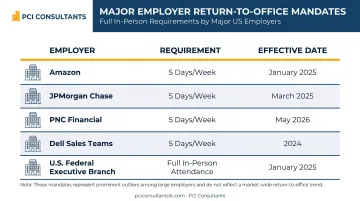
These mandates reflect deliberate decisions at specific organizations — not a market-wide shift.
Are Companies Going Back to 5 Days?
Gallup's current Hybrid Work Indicator shows remote-capable U.S. employees currently split as:
- 52% hybrid
- 26% exclusively remote
- 22% fully on-site
CBRE's 2025 Americas survey puts the average expected office presence at 3.2 days per week, with only 26% of organizations expecting 4–5 days. Full five-day mandates are a deliberate business decision at specific companies — not where the majority of employers are heading.
The Retention Risk Employers Cannot Ignore
- Six in 10 remote-capable employees prefer hybrid work
- Fewer than 10% prefer full-time on-site work
- 33% of executives and 19% of non-executives under RTO mandates planned to leave (Gartner, 2024)
When nearly a third of executives signal they'd leave over an RTO mandate, how the policy is designed and communicated becomes a direct driver of whether it succeeds — or triggers a departure wave. Worth noting for healthcare employers: most of your injury exposure sits with hands-on clinical staff who can't work from home, so your RTW program, not your RTO memo, is where the money is.
Key Components of an Effective Return-to-Work Policy
Whether the policy covers post-injury recovery or a hybrid-to-office transition, the structural requirements are largely the same. Gaps in any of the five components below tend to surface fast once the policy is tested.
Eligibility, Scope, and Activation
Define clearly:
- Who the policy covers (all staff vs. specific roles or locations)
- What activates it (workplace injury, extended illness, hybrid-to-office transition)
- What timeframes apply (when it takes effect, how long modified duty or phased re-entry lasts)
One practical add for multi-site owners: if you run several nursing homes under one entity, consolidating them under a single master policy usually earns better terms and lets one RTW standard apply consistently across every location instead of five different manager habits.
Workplace Accommodations and Modified Duty
For injured workers, accommodation assessment is both a legal requirement and your single biggest cost-control lever. JAN's 2025 accommodation cost report shows 61% of employer-reported accommodations cost nothing, with a median one-time cost of just $300 for those that do.
Common accommodation types include:
- Modified job tasks or reduced hours
- Ergonomic equipment adjustments
- Temporary reassignment to a different role — e.g., a nurse with a lifting restriction moved to reception, intake, or chart review
- Schedule flexibility during recovery
A ready-made light-duty policy and a standing inventory of these roles is what lets you act in days, not weeks.
Health, Safety, and Compliance Standards
Any RTW policy should document illness reporting protocols, workplace sanitation and safety standards, fitness-for-duty procedures before full return, and legal compliance under ADA, FMLA, and your state's workers' comp statutes. In healthcare, tie this to your existing infection-control and injury-reporting systems so a report reaches whoever is managing the claim the same day, not a week later.
Communication and Employee Acknowledgment
Inconsistent enforcement almost always traces back to inconsistent communication. Build in a written policy distributed through multiple channels, manager briefings before rollout, a designated point of contact, and signed acknowledgment forms. Managers who receive the policy the same day as employees — with no advance briefing — are the most common source of mixed messages.
Remote Work and Flexibility Guidelines
For your administrative staff, ambiguity is expensive. Specify required in-office days by role, hybrid schedule structure, how exceptions are requested, and work-from-home eligibility criteria. When these vary by manager rather than by documented policy, employees in identical roles end up with different schedules — and they notice.
Return-to-Work After Injury or Illness: The Workers' Comp Connection
Why Claim Duration Is the Core Cost Driver
Every day an injured worker sits on lost-time status costs you money — indemnity payments plus a reserve the insurer sets against your loss history. And here's what the insurance company won't tell you: left to its own devices, an insurer tends to pay a claim at or near its face value and call that a "win." A back-injury claim gets tagged as a "$250,000 claim" on a lawyer's inflated number, when the actual medical spend, managed properly, might be closer to $30,000 — and even that is paid incrementally, often $1,500–$2,000 a month, not as a lump sum.
NCCI reported both indemnity and medical lost-time claim severity rose 6% in accident year 2024 even as frequency fell — fewer claims, each costing more. A structured RTW program interrupts that spiral by shortening duration, and someone actively working the claim keeps the reserve honest.
The Phased Return Model
Waiting for full medical clearance before bringing a caregiver back is one of the most expensive mistakes an employer makes. A phased return — modified duties, reduced hours, or temporary reassignment — keeps the worker productive and earning while recovery continues. In practice, we've moved an injured nurse into a receptionist-type role within weeks, which sharply cuts the real cost of the claim.
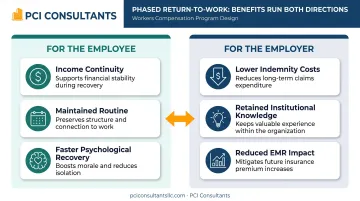
The benefits run both directions:
- For the employee: income continuity, maintained routine, faster recovery
- For the employer: lower indemnity, retained institutional knowledge, less damage to your experience rating
The key is matching available light-duty tasks to the worker's medically documented restrictions. That takes a structured modified-duty job inventory and supervisor training — the backbone of any real return-to-work program.
Genuine vs. Exaggerated Claims
Not every claim is what it's reported to be, and treating them all the same is how loss runs get bloated. Our approach is simple and firm: a genuine injury gets paid without dispute — no games, no delay. An exaggerated or fraudulent claim gets investigated and contested. That day-one urgent-care record we mentioned earlier is what makes the difference; it's the objective baseline that protects you when a minor strain later gets described as a career-ending injury. Guarding against workers' comp fraud isn't about denying care — it's about protecting your loss history and the premiums that ride on it.
Legal Obligations and State Variation
You must engage in the interactive process to identify reasonable accommodations, document every accommodation discussion, refrain from retaliating against employees who file claims, and coordinate ADA, FMLA, and state workers' comp where they overlap. State laws vary significantly — what's required in California or New York differs from Texas or Florida. Multi-state healthcare operators need a partner who knows those differences, which is where a no-cost policy review is a sensible first step.
The High-Deductible Connection
Those obligations don't exist in a financial vacuum. For qualifying businesses, a high-deductible or large-deductible program — where you retain a defined first layer, say the first $200,000 of a $500,000 structure, and the insurer covers the rest — can roughly halve your annual premium (for example, $100,000 down to $50,000). Not every business qualifies, and it only works when someone is actively administering the claims. Under that structure, retained claim payments are typically metered out monthly — on the order of $3,000/month — and stop when the condition resolves. RTW effectiveness stops being an HR nicety and becomes a direct balance-sheet variable.
The incentive chain works like this:
| Without Active RTW Management | With Structured RTW |
|---|---|
| Longer lost-time duration | Shorter lost-time duration |
| Reserve set at inflated face value | Reserve corrected to real cost |
| Higher retained claim cost | Lower retained claim cost |
| Higher loss values feeding your mod | Lower loss values feeding your mod |
| Premium increase that rarely reverses | Premium savings that compound |
One more thing worth being blunt about: because we're paid by commission from the insurer — not by how many claims you file or how much they cost — we have no incentive to let a claim run. Our interest and yours point the same direction: resolve it fast, at its real cost. For employers paying $100,000+ in annual premium, that's where premium savings are won or lost, and it feeds straight into your experience rating.
Best Practices for Implementing Your RTW Policy in 2026
Lead with Management Practices, Not Just Mandates
McKinsey's 2025 research on office re-entry makes a direct point: the working model matters less than the environment leaders create. The same is true on the injury side — a modified-duty policy nobody activates is just paper. Treat the policy as an enabler and make sure someone owns each claim from day one.
Use a Phased Implementation Approach
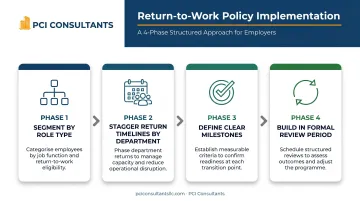
A single hard-cutover date creates friction. Instead:
- Segment by role type — identify which roles genuinely require in-person presence vs. those where it's preferred; on the injury side, this is also where you classify your workforce by actual risk (clerical vs. hands-on clinical) so you're not overpaying premium on low-risk roles
- Stagger timelines by department to reduce disruption
- Define clear milestones with measurable criteria before advancing
- Build in a formal review period where adjustments are expected
Train Managers Before Rollout
Manager quality is the biggest variable in whether RTW policies work — for both office re-entry and post-injury recovery. Managers need clear guidance on accommodation requests, scripts for RTW conversations with recovering staff, consistent standards, and escalation paths for complex situations. On the injury side, the most important instruction is the simplest: an incident gets reported to the claims contact immediately, so the medical record and the return-to-work clock both start on day one.
Build a Feedback Loop
Employee input at the design stage measurably improves buy-in. Run pulse surveys before and after, track the metrics in the next section, and update the policy iteratively — it should evolve with each review cycle.
Measuring the Success of Your Return-to-Work Policy
Office Re-Entry Metrics
To evaluate whether RTO policies are working, track voluntary turnover rate (pre- vs. post-policy, segmented by role), absenteeism trends against a baseline (BLS shows a 3.2% absence rate for full-time workers), engagement scores from pulse surveys, and accommodation request volume. Watch for patterns: certain departments or managers consistently showing higher non-compliance usually signal a training gap, not an attitude problem.
For injury-related RTW programs, the metrics shift entirely — from workforce engagement to claim economics.
Workers' Comp Claims Metrics
For injury/illness RTW programs, the KPIs that matter are:
- Average claim duration — in days, segmented by injury type and job class
- Reserve vs. actual paid — the gap between the insurer's "lawyer number" and real incremental spend is where an advocate earns their keep
- RTW rate within 30/60/90 days — how fast injured staff reach modified duty
- Medical-only to lost-time conversion rate — keeping this low is the highest-impact cost variable in your program
- Experience-mod trend over a rolling 3-year period — the downstream indicator, and a reminder that once your mod rises, it rarely drops back quickly
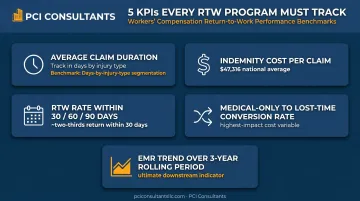
If these numbers aren't moving after 12–18 months, the issue is usually claim-reporting delays or thin modified-duty options — both fixable through program design, not policy rewrites. Individual results vary, but employers who actually work the claim consistently see shorter durations and lower retained cost.
The Concrete Next Step
If you want to know what your program is actually costing versus what it should, the review is straightforward. Send us two things: a copy of your current workers' comp policy and your five-year loss runs. That's enough for us to spot inflated reserves, stalled claims, and roles you're over-rated on — and to tell you honestly whether a structured RTW program or, for qualifying businesses, a high-deductible structure would move the number.
Frequently Asked Questions
What are the key return-to-work guidelines?
A solid RTW policy includes a written modified-duty framework, immediate incident reporting with same-day medical care where warranted, early communication with the employee and treating physician, phased return timelines, formal accommodation assessments, and documented ADA/FMLA/state workers' comp compliance. The guideline that matters most in practice: get the medical record and the return-to-work clock started on day one.
Are companies going back to 5 days in office?
Some large employers — Amazon, JPMorgan, PNC — have moved to 5-day in-office requirements, but it remains a minority approach. Gallup's current data shows 52% of remote-capable employees still hybrid, with average expected office presence around 3.2 days per week. For healthcare employers, this matters less than your injury RTW program, since most of your exposure is hands-on staff who can't work remotely anyway.
How do return-to-work programs affect workers' compensation costs?
They cut claim duration by getting injured staff into modified or light-duty roles sooner — an injured nurse into a receptionist-type role within weeks, for example. Shorter duration means lower indemnity, a lower reserve, and lower loss values feeding your experience mod, which reduces premium over time. Because premium increases rarely reverse once they hit, avoiding the inflated claim in the first place is worth far more than fixing it after the fact.
Is a big workers' comp claim really as expensive as the insurer says?
Usually not. A claim reported as a "$250,000 claim" is often a lawyer-inflated figure, not the real cost. Managed properly, the actual medical spend on that same injury might be around $30,000 — paid incrementally, roughly $1,500–$2,000 a month, not in a lump sum. Without an advocate working the file, insurers tend to pay near face value and call it a win. Individual results vary, but the gap between the reserve and reality is often large.
What accommodations must employers provide for injured workers returning to work?
You must engage in an interactive process to identify reasonable accommodations — modified duties, flexible hours, ergonomic adjustments, or temporary reassignment (a lifting-restricted nurse moved to reception or intake, for instance). ADA and state workers' comp govern these obligations. Per JAN's 2025 data, 61% of accommodations cost nothing, which neutralizes the "too expensive" objection.
How do you tell a genuine claim from an exaggerated one — and does contesting claims hurt employees?
Genuine injuries get paid without dispute; that's non-negotiable. Exaggerated or fraudulent claims get investigated and contested — and the objective day-one medical record is what makes that possible. Protecting your loss history isn't about denying care to hurt workers; it's about making sure a minor strain doesn't get paid as a career-ending injury and drive your premiums up for years.