The cost of a single misstep can be staggering. For the 14th consecutive year, healthcare has had the highest data breach costs of any industry, with the average incident costing USD $9.77 million in 2024. But the risk that quietly drains the most money year after year is the one you can actually control: workers' compensation. This is where the right consulting partner stops being a vendor and starts being an advocate, and where the difference between a firm that places your policy and a firm that manages your claims shows up in real dollars.
Key Takeaways
- Effective risk management is vital for patient safety, HIPAA compliance, and financial health, but workers' comp is usually the largest controllable cost.
- The best consultants don't just place a policy, they handle the claim directly for the life of the policy, so you call your advocate, not the insurer.
- Day-one action, an accurate medical record, fast light-duty return to work, and fraud detection separate a real specialist from a generalist.
- This review covers top enterprise-level firms and specialists in high-cost areas like workers' comp.
The Evolving Landscape of Healthcare Risk Management
Insurance consulting for healthcare risk management is a specialized field focused on identifying, assessing, and mitigating the unique dangers found in clinical and operational settings. It moves beyond simply placing policies to building a comprehensive strategy that protects patients, staff, and the financial health of a healthcare organization.
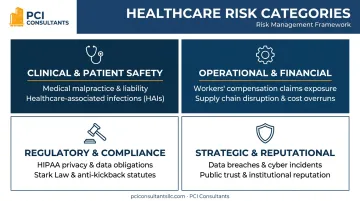
The risks are diverse and interconnected, typically falling into four main categories.
Clinical & Patient Safety Risks
These are risks directly related to patient care. They include medical malpractice, medication errors, patient falls, and hospital-acquired infections (HAIs). The impact on patient outcomes and the organization's financial stability can be severe. On any given day, approximately 1 in 31 U.S. hospital patients has at least one healthcare-associated infection, leading to significant costs and compromised care.
Operational & Financial Risks
These risks stem from the business of running a healthcare facility. While issues like supply chain disruptions and billing errors are significant, one of the largest and most controllable costs is workers' compensation. In 2023 alone, the private healthcare and social assistance sector recorded 562,500 nonfatal injuries and illnesses, driving up insurance premiums and impacting staff morale. Lifting injuries, needle sticks, and slips in a nursing home or home health setting are frequent, and each one becomes a claim that can follow your loss history for years.
Here's what the insurance company won't tell you: once your premium goes up after a claim, it rarely comes back down, even after the claim is fully resolved. That's why how a claim is handled in the first 48 hours matters more than almost anything else on this list.
Regulatory & Compliance Risks
The healthcare industry is governed by a complex web of regulations. Violations of HIPAA, the Stark Law, or the Anti-Kickback Statute can result in severe penalties. As of August 2024, HIPAA fines can reach over $71,000 per violation and more than $2.1 million for repeat offenses, making compliance a mission-critical priority.
Strategic & Reputational Risks
These risks threaten an organization's long-term viability and public trust. Cybersecurity breaches, negative patient outcomes that damage public perception, and challenges with mergers and acquisitions all fall into this category. A single data breach or high-profile safety event can erode community trust that took decades to build.
A proactive, consultant-guided approach is crucial. By focusing on high-frequency, high-cost areas like workers' compensation and actively managing every claim, organizations can lower their total cost of risk, improve staff safety, and strengthen their overall financial posture. A structured risk management program for workers' comp is where most healthcare employers find the fastest, most measurable savings.
What Actually Separates a Great Firm From a Good One
Most brokers place a policy and then step back. When a nurse gets hurt, you call the insurer, the insurer opens a file, and, left alone, the insurer tends to pay the claim at or near face value and call it a "win." That is the default behavior, and it costs you twice: once on the claim, and again on the premium that never fully comes back down.
The firms worth paying for do something different. They handle the claim directly for the life of the policy, meaning your administrator calls them, not the carrier. When an aide reports a back strain, they can evaluate the incident immediately and send the worker to urgent care that same day, creating an accurate, timely medical record. That record is your best protection against a minor injury being exaggerated into a major one weeks later.
They also correct what we call the "lawyer number." A claim that gets reserved at $250,000 on paper often resolves to something closer to $30,000 in actual medical spend, paid incrementally, typically around $1,500 to $2,000 a month, not handed over as a lump sum. Left unmanaged, that inflated reserve sits on your loss runs and inflates every future quote. Genuine injuries get paid without dispute; exaggerated or fraudulent ones get investigated and contested. A firm that does insurance fraud prevention as a core discipline protects both your loss history and your renewal.
Finally, they get people back to work faster. An injured nurse who can't be on the floor can often move into a light-duty, receptionist-type role within weeks. That single transition sharply cuts the real cost of the claim and keeps a valued employee attached to your organization. A formal return-to-work program is one of the most reliable levers a healthcare employer has. Individual results vary, but the pattern is consistent.
Top Insurance Consulting Firms for Healthcare Risk Management in 2026
The firms below were selected based on their deep healthcare industry expertise, comprehensive service offerings, client reputation, and, above all, how actively they manage the claims and premiums that drive your total cost of risk.
Marsh
As one of the world's largest insurance brokers, Marsh has a dedicated Healthcare Practice serving thousands of organizations. Its key differentiator is the ability to leverage massive datasets and analytics for benchmarking and predictive modeling, helping large systems manage complex, enterprise-wide risks.
- Key Healthcare Services: Clinical risk management, medical professional liability, workers' compensation consulting, and cyber risk solutions.
- Ideal For: Large hospital systems, academic medical centers, and multi-state healthcare networks needing a full suite of services.
- Unique Value: Unmatched global resources and data analytics for complex risk financing and mitigation strategies.
Aon
Aon is a global firm with a strong focus on health and human capital solutions, making it a leader in addressing risks related to the healthcare workforce. Its standout feature is a holistic approach that connects employee wellbeing programs to workers' compensation and patient safety, helping clients build a resilient and safe workforce culture.
- Key Healthcare Services: Workforce resilience, casualty risk consulting, claims management, and enterprise risk management (ERM).
- Ideal For: Healthcare organizations focused on integrating employee health and safety with broader risk management goals.
- Unique Value: Deep expertise in linking human capital strategy to financial risk mitigation.
PCI Consultants
PCI Consultants is a specialized risk management firm with over 30 years of experience focused on workers' compensation, the highest-cost, most controllable exposure most healthcare employers carry. What sets PCI apart is that they don't just place your policy and disappear; they handle the claim directly for the life of the policy. When a worker is injured, your team calls PCI, not the carrier. PCI evaluates the incident immediately, can route the employee to urgent care the same day to lock in an accurate medical record, moves eligible staff into light duty within weeks, and pays legitimate claims without dispute while investigating the exaggerated ones.
That hands-on model is how PCI corrects inflated reserves, structures claim payments monthly instead of as lump sums, and protects your loss runs so your premium doesn't drift up and stay up. Because PCI is paid by commission from the insurer rather than by your claims volume, the firm isn't incentivized to let claims run high. For qualifying employers, PCI also designs high-deductible programs that can roughly halve annual premium, and works with niche providers like CDPAP and home health companies.
- Key Healthcare Services: Direct claims handling, workers' compensation program design, high-deductible and risk-retention structures, risk control, and premium reduction strategies.
- Ideal For: Hospitals, nursing homes, home health and CDPAP companies, and any provider with significant workers' comp exposure (typically 100+ employees, $100K+ in annual premium).
- Unique Value: Deep specialization in workers' compensation with active, direct claims handling that produces better claims outcomes than generalized providers. Individual results vary.

Gallagher
Gallagher is a major global brokerage known for its strong, industry-specific expertise. Its dedicated healthcare practice serves a wide range of clients, from single physician practices to large health systems. Its key strength is a "high-touch," relationship-driven consulting model combined with powerful analytical tools, making sophisticated risk management accessible to mid-market healthcare organizations.
- Key Healthcare Services: Medical malpractice consulting, risk control services, claims advocacy, and employee benefits consulting.
- Ideal For: Mid-sized hospitals, physician groups, and long-term care facilities.
- Unique Value: A blend of personalized service and comprehensive capabilities tailored to the mid-market.
Milliman
Milliman is a premier global consulting and actuarial firm renowned for its quantitative expertise. Its differentiator is providing deep actuarial and financial insights that help healthcare organizations with risk financing, self-insurance programs, and navigating the complexities of value-based care models. They bring world-class data science to solve complex financial risk challenges.
- Key Healthcare Services: Actuarial analysis, healthcare reform consulting, health and welfare benefits, and medical underwriting support.
- Ideal For: Self-insured healthcare systems, health plans, and organizations transitioning to value-based payment models.
- Unique Value: World-class actuarial and data science expertise for solving complex financial risk challenges.
High-Deductible Programs and Risk Classification: Two Levers Most Healthcare Employers Overlook
Beyond how claims are handled, two structural moves quietly reshape a healthcare employer's total cost of risk.
The first is a high-deductible program. For qualifying businesses, the employer takes on a defined first layer of loss, say the first $200,000 of a $500,000 program, while the insurer covers the rest. Structured well, this can roughly halve your annual premium (for example, from $100,000 down to $50,000). Claim payments are made monthly, often around $3,000 a month, and stop when the condition resolves, rather than being pre-funded as a lump sum. The catch is that it only works when someone is actively administering the claims, and not every business qualifies. A specialist who already handles your claims directly is the natural partner to run a self-insured or large-deductible structure.
The second is risk classification. A hospital or nursing home doesn't have one risk profile, it has several. Clerical and administrative staff carry a fraction of the injury risk that hands-on clinical and lifting-intensive roles do. When your workforce is properly segmented by actual risk, you stop overpaying premium on the low-risk half of your payroll. Multi-location owners, such as a group running several nursing homes, can often consolidate into a single master policy for better terms. Smaller or newer providers can be grown into stronger programs over time.
How We Selected the Top Firms for This List
Our evaluation process focused on firms that offer demonstrable value specifically for the healthcare sector, not just general insurance advice. We prioritized partners who understand the unique pressures of a clinical environment.
The key criteria used for selection included:
- Possess a dedicated healthcare practice with deep regulatory knowledge (HIPAA) and a proven track record in clinical environments.
- Actively manage claims, not just place policies, with a clear process for day-one medical records, light-duty return to work, and fraud detection.
- Offer a comprehensive range of services, from clinical risk assessment to workers' compensation cost reduction, with clear evidence of quantifiable results.
- Have a strong industry reputation backed by client success stories and meaningful contributions to healthcare risk management.
Conclusion
Choosing the right insurance consulting partner is a strategic decision that directly impacts your organization's financial health, patient safety, and operational resilience. The best choice always depends on your specific needs.
A large hospital system might need the broad capabilities of a global firm like Marsh or Aon. But a healthcare facility watching its workers' comp premium climb every year, especially a nursing home or home health provider, will see a far greater impact from a specialist who handles the claim directly and fights the inflated numbers that quietly raise your renewal.
Firms like PCI Consultants focus on exactly that: actively managed workers' comp programs that correct inflated reserves, return injured staff to light duty faster, and keep your loss history clean so premiums stay controlled. The concrete first step is simple. Send us a copy of your current workers' comp policy and your five-year loss runs, and we'll show you where your dollars are actually going.
Frequently Asked Questions
What are risk management tools in healthcare?
Risk management tools are systems and services, not just software. Key examples include Root Cause Analysis (RCA) to investigate adverse events, Failure Mode and Effects Analysis (FMEA) to identify process weaknesses, and comprehensive risk assessments. In the workers' comp world, the most valuable "tool" is a firm that handles claims directly, creates a day-one medical record, and administers payments so a minor injury never balloons into an inflated reserve.
What are the five methods of risk management in insurance?
The five common methods are Avoidance (eliminating the risk), Retention (self-insuring or taking a defined deductible layer), Spreading (diversifying risk), Loss Prevention and Reduction (safety programs and fast return to work), and Transfer (purchasing an insurance policy). For qualifying healthcare employers, a high-deductible program blends retention and transfer, and can roughly halve annual premium when the claims are actively managed. Not every business qualifies.
Why is risk management so critical in the healthcare sector?
It's crucial for ensuring patient safety, protecting sensitive data (HIPAA compliance), preventing financial losses from malpractice and staff injuries, and maintaining public trust and accreditation. Workers' comp deserves special attention because once a claim inflates your loss runs, your premium rarely comes back down, even after the claim resolves. Managing the claim early is what protects you for years.
How do I choose the right insurance consulting firm for my hospital?
First, identify your primary risk challenges (malpractice claims, staff injuries, cyber threats). Then look for a firm with proven experience solving those exact problems in a healthcare setting. For workers' comp specifically, ask one question: when an employee is injured, do we call you or the insurer? A firm that handles the claim directly, sends the worker to urgent care on day one, and moves eligible staff into light duty will outperform one that simply forwards the file to the carrier.
What is the difference between clinical and operational risk in healthcare?
Clinical risk relates to patient care and safety (misdiagnosis or surgical errors). Operational risk stems from day-to-day business functions, such as employee injuries, billing errors, or IT system failures. In most nursing homes and home health agencies, lifting and slip injuries make workers' compensation the single largest operational risk, and the most controllable one when claims are actively managed.
How can a consultant help with workers' compensation in a healthcare setting?
A good consultant analyzes claims data to spot injury trends like patient-lifting strains, implements targeted safety and return-to-work programs, and structures cost-effective plans such as high-deductible options for qualifying employers. The real difference-maker is direct claims handling: evaluating each incident immediately, building an accurate medical record, paying legitimate claims without dispute while contesting exaggerated ones, and correcting the inflated "lawyer number" so a $250,000 reserve resolves closer to its true cost, often near $30,000, paid incrementally rather than as a lump sum. Individual results vary.