But what if your premium directly reflected how well your claims were actually handled, not how badly an insurer assumed they might go? That's the core idea behind loss-sensitive workers' compensation insurance. It moves risk (and savings) back onto your books, so a well-run program pays you back.
Here's the catch the insurance company won't put in the brochure: a loss-sensitive plan only saves money if someone actively manages the dollars inside your deductible. Left alone, insurers tend to pay claims at or near face value and call it a win. This article breaks down what these plans are, the real numbers behind them, who qualifies, and how disciplined claims management turns a fixed cost into a competitive advantage.
A Quick Guide to Loss-Sensitive Workers' Comp (TL;DR)
- Loss-sensitive plans swap a high fixed premium for a lower upfront cost plus a share of your actual claim expenses, usually through a large deductible.
- For qualifying employers, a high-deductible structure can roughly halve annual premium (for example, $100K to $50K), with claim payments spread monthly instead of a lump sum.
- The savings are real only when claims are handled directly and aggressively, day one urgent-care records, fast light-duty return, and pushback on exaggerated claims.
- Not every business qualifies. Success hinges on partnering with someone who manages the claim for you, not an insurer paying the inflated "lawyer number."
What is Loss-Sensitive Workers' Compensation?
A loss-sensitive program is a workers' comp policy where your final premium is tied to your company's actual claim losses during the policy period. Instead of paying a fixed price built around the worst-case scenario, you take on a defined first layer of loss, the insurance carrier covers the catastrophic excess, and you keep the savings when claims are contained.
This stands in sharp contrast to traditional guaranteed-cost plans, where the premium is set in stone on day one, regardless of whether you have a clean year or a dozen claims.
The Core Difference: Guaranteed Cost vs. Loss-Sensitive Plans
Guaranteed-cost policies are simple and predictable. The premium is calculated at the start of the year based on payroll and class codes, and the insurer assumes 100% of the risk. Think of it like a fixed-price, all-you-can-eat buffet: you pay one price upfront, and it doesn't matter how much or how little you actually consume. The problem is that the insurer prices in the worst case, and you fund it.
Loss-sensitive policies operate on a shared-risk model. You pay a much lower fixed premium for administration and catastrophic coverage, then reimburse the insurer for claims up to a defined limit. It's more like a pay-per-item menu: your entry cost is low, but your final bill depends on what you actually order, your claims. That's exactly why loss control and hands-on claims handling stop being optional and start being the whole point.
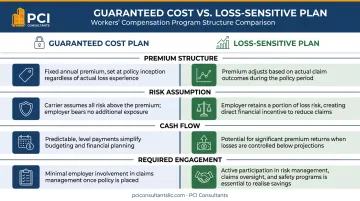
Here's a simple breakdown of the differences:
| Feature | Guaranteed Cost Plan | Loss-Sensitive Plan |
|---|---|---|
| Premium Structure | Fixed and predictable for the year | Lower fixed cost + variable claim costs |
| Risk Assumption | 100% transferred to the carrier | Shared between your business and the carrier |
| Cash Flow | Large premium paid upfront | Lower upfront premium; claims paid monthly as they occur |
| Required Engagement | Low; "set it and forget it" | High; requires active claims and risk management |
The Financial Trade-Off: Weighing Risks and Rewards
Choosing between these plans is a strategic decision. You're trading the budget certainty of a guaranteed-cost policy for the real savings potential of a loss-sensitive program, savings that depend entirely on how the claim dollars are managed.
The Reward: Lower Premiums and Better Cash Flow
Because the carrier isn't pricing your policy to absorb every conceivable loss, the fixed portion of your premium drops sharply. In practice, for a qualifying employer, a well-structured high-deductible program can cut annual premium roughly in half, for example, from $100,000 to about $50,000.
The cash-flow benefit is just as important, and it's widely misunderstood. You don't hand over a giant lump sum for a claim. Workers' comp claims pay out incrementally over time. A back injury that an insurer reserves at a scary number might really cost around $30,000 in actual medical spend, paid at roughly $1,500 to $2,000 a month, and the payments stop when the condition resolves. On a high-deductible program, claim payments are structured monthly (often around $3,000/mo) and administered actively rather than being written off in one settlement. That keeps your capital working in the business. For a deeper look at the return math, see our breakdown of premium reduction ROI.
The "Lawyer Number" Problem
Here's what makes or breaks a loss-sensitive plan. When a claim comes in, an unmanaged file often carries an inflated figure, call it the "lawyer number." A file might be reserved and pursued as a $250,000 claim when the real, documented cost is closer to $30,000. Without an advocate, insurers tend to pay at or near that inflated face value and call it a win, because minimizing your cost isn't their job.
On a guaranteed-cost policy, that overpayment is hidden inside your renewal. On a loss-sensitive policy, you are paying those dollars directly, so the gap between the lawyer number and the real number is your money. That's why direct claims handling, and challenging exaggeration, is the difference between a program that saves and one that quietly bleeds.
The Risk: Financial Responsibility and Collateral
The savings don't come for free. By sharing the risk, your business takes on new responsibilities:
- Direct claim responsibility: You reimburse the insurer for claims paid within your deductible. This is a variable expense, but these programs include a critical safeguard, an aggregate stop-loss that caps your total claim payments for the year and protects you from a catastrophic event.
- Collateral requirements: Insurers want assurance you can cover your share. This is usually handled through collateral such as an Irrevocable Letter of Credit (ILOC) or cash set aside, which can tie up a line of credit.
- Premium stickiness works both ways: On any plan, once a bad claim year pushes your premium up, it rarely comes all the way back down, even after the claim resolves. That multi-year cost is exactly why controlling severity in the moment matters so much.
Key Types of Loss-Sensitive Programs
Loss-sensitive plans come in a few forms, but most mid-sized and larger healthcare employers start with one of two.
High-Deductible Plans
This is the most common and straightforward option. Your business takes on a defined first layer of loss, for example, the first $200,000 of a $500,000 program, while the insurer covers everything above it. In exchange, your upfront premium drops substantially. The insurer still pays claims from the first dollar, then bills you back for payments inside your deductible, and those payments are structured monthly and stop when the condition resolves. Done right, this is where the roughly-halved premium comes from. It's also where active administration earns its keep, which is why we manage these large-deductible programs directly rather than handing you a policy and walking away.
Retrospective Rating Plans ("Retro")
A retrospective plan is more complex. You pay a provisional premium at the start of the term, and at the end the insurer recalculates your final premium up or down based on your actual losses, subject to a pre-agreed minimum and maximum. You know your best- and worst-case scenarios from day one, but the outcome still rides on how well claims were contained during the year.
Other Options
Further along the risk-sharing spectrum sit dividend plans, self-insured programs, and captives. These give up more premium certainty for more control. For most companies, though, a high-deductible plan is the most accessible way to take back control of workers' comp costs.
Is Your Business a Good Candidate?
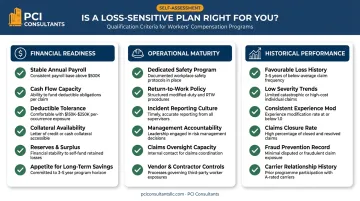
These programs offer real rewards, but they aren't for everyone, and not every business qualifies. Success requires a specific mix of financial stability and operational discipline.
Financial Readiness
- Meaningful annual premium. These structures make sense once you're spending well into six figures, commonly $100K+ in annual workers' comp premium, with larger assigned-risk retro plans keyed off higher thresholds.
- Stable cash flow and credit sufficient to handle monthly claim reimbursements and post collateral without disrupting operations.
Operational Maturity
- A real safety culture and honest risk classification. Your clerical and administrative staff shouldn't be rated like your hands-on caregivers. Segmenting the workforce by actual risk means you're not overpaying on low-risk roles, and it keeps the deductible layer honest.
- A workable return-to-work program. The single biggest lever on real claim cost is getting people back on light duty fast, an injured nurse moved into a receptionist-type role within weeks instead of sitting home for months. See how a return-to-work policy drives this.
Historical Performance
- A stable, readable claims history. Frequent low-severity claims are manageable; a pattern of erratic, catastrophic losses can make a loss-sensitive plan too volatile. This is exactly why we ask for five years of loss runs before recommending a structure.
Partnering for Success: The PCI Consultants Advantage
Switching to a loss-sensitive program is a major move, and managing it well takes expertise most businesses don't have in-house. This is where a specialized broker who actually handles your claims becomes the difference between paper savings and real ones.
At PCI Consultants, we've spent over 30 years helping employers, especially in high-injury healthcare settings, transition to and master high-deductible workers' comp programs. Here's what sets our approach apart, and why it matters more on a loss-sensitive plan than any other:
- We handle the claim directly, for the life of the policy. When someone is hurt, you call us, not the insurer. We evaluate the incident immediately and, when appropriate, send the injured worker to urgent care the same day. That day-one medical record creates an accurate, timely baseline that protects you against later exaggeration.
- We separate legitimate claims from inflated ones. Genuine injuries get paid without dispute, fast. Exaggerated or fraudulent claims get investigated and contested. Our fraud investigation work keeps the lawyer number from becoming your number, protecting both your deductible spend and your future loss history.
- We move people back to work. Structured light-duty transitions cut real claim cost sharply, often within weeks.
- We're not incentivized by your claims. We're paid by commission from the insurer, not by your claims volume, so our interest is squarely in keeping your losses down.
Multi-location owners, say, several nursing homes under one parent, can often consolidate into a single master policy for better terms, and smaller operations can be grown into these programs over time. Individual results vary, but the pattern is consistent: an actively managed loss-sensitive plan beats a passively purchased one, every time.
Your Concrete Next Step
We don't start with a generic quote. To tell you whether a loss-sensitive structure fits, we need two things: a copy of your current workers' comp policy and your five-year loss runs. Send those over and we'll review your program design and claims handling and come back within 24 hours with a straight answer, no obligation. Start with a no-cost consultation.
Frequently Asked Questions
How does loss-sensitive workers' comp insurance work?
Your final premium is tied to your actual claims. You take on a defined first layer of loss, usually through a large deductible, in exchange for a much lower upfront premium. Claims inside that layer are paid incrementally, often monthly, not as a lump sum, and the catastrophic excess stays with the insurer. The savings depend on how tightly those claim dollars are managed.
What is the difference between guaranteed cost and loss-sensitive workers' compensation?
Guaranteed cost is a fixed, predictable premium where the insurer takes all the risk and prices in the worst case. Loss-sensitive gives you a lower but variable cost where you absorb a managed layer of loss. The trade-off: guaranteed cost hides overpayment inside your renewal, while on a loss-sensitive plan, every inflated "lawyer number" dollar is coming straight out of your pocket, which is why active claims handling matters so much.
How much can a loss-sensitive plan actually save?
For a qualifying employer, a well-structured high-deductible program can roughly halve annual premium, for example, from $100,000 to about $50,000. But that's the design; the realized savings come from containing claim severity. Not every business qualifies, and individual results vary.
What kind of collateral is required?
Most commonly an Irrevocable Letter of Credit (ILOC) from a bank, or cash set aside. It assures the insurer you can meet your deductible obligations. Because it can tie up a credit line, we factor collateral into the program design up front rather than letting it surprise you at renewal.
What is an aggregate stop-loss and why does it matter?
It's a cap on your total claim payments for the policy year. Below the cap you pay for claims as they occur; above it, the insurer absorbs the rest. It's the safeguard that keeps a bad claim year from turning into a catastrophic financial event, and it's a non-negotiable part of any loss-sensitive structure we build.
Do we still control the claims, or does the insurer?
On our programs, you effectively do, because we handle the claim directly on your behalf. You call us, not the insurer. We create the day-one urgent-care record, pay legitimate injuries without dispute, contest exaggerated ones, and drive fast light-duty return. Left to default, insurers tend to pay claims at or near face value and call it a win; an advocate keeps your real cost, and your future premium, down.