This guide is written for you, the carnival operator. We will walk through the real risks your business carries, the compliance rules a mobile workforce has to meet, and, most importantly, what actually happens to a claim after a worker gets hurt, because that is where most operators quietly lose the most money. Here is the part the insurance company will not volunteer: left alone, an insurer tends to pay your claims at close to face value and move on. Someone has to push back on your behalf, claim by claim, for the life of the policy.
TL;DR: Key Takeaways for Carnival Operators
- High-risk by nature: Constant travel, heavy rides, work at height, and a transient crew put carnivals in a high-hazard class with premiums to match.
- Multi-state compliance is not optional: A standard state-bound policy leaves gaps the moment your convoy crosses a line. You need the right endorsements and correct payroll classification.
- The claim is where the money is: A '$250,000 claim' often reflects closer to $30,000 in real cost, paid a few thousand a month, not as a lump sum. Whether it ends up at the low number or the high one depends on who is managing it.
- A specialist who handles the claim beats a broker who sells the policy: You want a partner who takes the injured-worker call directly, builds an accurate record day one, and contests what deserves contesting.
Why Traveling Carnivals Face Unique Workers' Comp Risks
From an insurer's desk, a traveling carnival is a perfect storm: heavy equipment, public interaction, a workforce that turns over constantly, and a business that is literally in motion. That combination lands the industry in a high-hazard rating tier before a single incident happens.
The U.S. Bureau of Labor Statistics reports the broader Amusement, Gambling, and Recreation industry sees about 3.3 recordable injuries for every 100 full-time workers, and the exposures specific to a traveling show are sharper still.
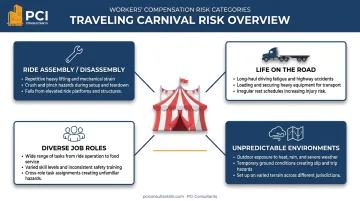
Ride Assembly, Operation, and Disassembly
Setup and teardown are the most dangerous phases of carnival work. Crews race a schedule, and speed breeds mistakes:
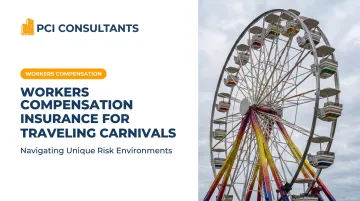
- Working at height to assemble large rides like a Ferris wheel, with serious fall exposure.
- Wiring complex power systems for lights and motors, introducing electrical hazards.
- Lifting heavy structural components in awkward positions, driving strains and overexertion claims, the single most common and most exaggerated category.
The Dangers of Life on the Road
The 'traveling' in traveling carnival is a risk many operators underestimate. A real slice of your liability lives between venues, not on the midway. Driver fatigue is the quiet killer here. A landmark Federal Motor Carrier Safety Administration study found fatigue was a factor in 13% of crashes involving large trucks. Long hauls and overnight drives put the whole convoy at risk, and injuries loading or unloading transport count too.
A Mix of Diverse and High-Hazard Jobs
A carnival is a small city on wheels, and every role carries its own risk profile:
- Ride operators face repetitive motion, weather exposure, and the stress of watching public safety.
- Food vendors risk burns from hot oil, slips on greasy floors, and cuts during prep.
- Game attendants deal with repetitive strain from handling prizes and equipment.
- Maintenance crews are exposed to mechanical, electrical, and hydraulic hazards.
That spread matters for premium, not just safety. A ticket-booth clerk and a ride-assembly hand should not be rated the same. When your workforce is segmented by actual risk instead of lumped into one high-hazard bucket, you stop overpaying on the low-risk roles. Getting that classification right is one of the first things we check on any policy we review.
Unpredictable Environments and Public Interaction
Unlike a fixed park, your worksite changes every week: a grassy, uneven field one stop, a paved lot the next. That means unstable footing for equipment, new trip hazards, weather exposure, and occasional friction with the public. It is a recipe for unpredictable injuries, which is exactly why how you handle each incident matters more than in a controlled, fixed environment.
Workers' Comp 101: The Non-Negotiable Basics for Carnivals
Workers' comp is a state-mandated, no-fault system. It gives an injured worker medical care, disability benefits, and wage replacement, and in return the worker generally cannot sue you over the injury. For carnival operators the rule is simple: it is not optional. It is legally required in nearly every state for businesses with employees, including the seasonal and temporary staff who are the backbone of your operation.
The penalties for going without are steep. New York can impose fines of $2,000 for every 10-day period of non-compliance; California penalties start at $10,000. States can also issue stop-work orders that shut your operation down mid-season, and an uninsured injured worker can sue you directly for damages and lost wages.
Navigating a Mobile and Seasonal Workforce
The biggest coverage hurdle for a traveling show is the mobile, seasonal crew. A standard policy is tied to a home state, and the moment you cross a line that policy can go quiet.
Multi-State Compliance and Coverage
To run legally on the road, you need a policy built for a mobile business, which usually means an 'All-States' or 'Other States' endorsement. It extends coverage into states you travel to, but with a catch: you generally have to list every potential state of operation up front. Roll into a state you never listed and you may have no coverage there. Operators running multiple shows or several units under one owner can often consolidate into a single master program for cleaner terms than juggling separate policies, though whether that fits depends on your structure.
Managing Seasonal and Temporary Employees
State law is clear: seasonal, temporary, and part-time workers have the same comp rights as your permanent staff, from day one. That makes accurate payroll reporting by correct class code non-negotiable. Under-report or miscode and you can get hit with a surprise back-premium bill at the year-end audit, or worse, a coverage fight when a claim comes in.
Injuries In-Transit
If a worker is hurt in a vehicle wreck driving from an Ohio fair to a Pennsylvania one, that falls under 'course and scope of employment.' Because travel is a required part of the job for carnival crews, injuries during that work travel are generally covered, unlike an ordinary daily commute. These are also the claims most worth managing closely, because auto-involved injuries are where inflated figures show up fastest.

What Actually Happens to a Claim, and Why It Costs What It Costs
Here is the part that separates a policy from a partner. When a worker gets hurt, the number you first see is almost never the real number.
Say a reserve gets set at $250,000 on a back injury from a teardown. That figure is what we call the lawyer number, the worst-case, everything-goes-wrong estimate. The actual medical spend on a claim like that often lands closer to $30,000, and it is not written as one check. It is paid incrementally, typically $1,500 to $2,000 a month, and the payments stop when the condition resolves. The gap between $250,000 and $30,000 is not luck. It is management.
Left alone, an insurer has little reason to fight that number down. Paying a claim near its face value and closing the file counts as a 'win' inside a large carrier. That is the default, and the insurance company will not tell you it is costing you.
We work the other way. Because we are paid by commission from the insurer and not tied to your claims volume, we have no reason to let a claim run hot. Our whole job is to keep your real cost down. That means:
- We take the call, not the insurer. For the life of the policy, an injured worker's incident comes to us first. We evaluate it immediately and, when it is warranted, send the worker to urgent care that same day. A prompt, accurate medical record is your single best protection against a minor strain becoming a six-figure story weeks later.
- We pay the real ones and fight the fake ones. A legitimate injury gets paid without a runaround, that is the deal, and it is the right thing to do. But an exaggerated or fraudulent claim gets investigated and contested. In a high-turnover, seasonal workforce, that discipline matters.
- We move people back to work fast. A light-duty return-to-work program gets a hurt assembly hand into a ticket booth or a gate role within weeks instead of sitting home collecting wage replacement, the most expensive part of most claims. Individual results vary, but a claim you close in weeks costs a fraction of one you let drift.
Why One Claim Is a Multi-Year Cost
There is a reason we treat every claim as if the money is your own: once a claim inflates your loss history and pushes your premium up, it rarely comes back down, even after the claim resolves. The premium is sticky. So minimizing a claim today is not a one-season savings; it is protecting your rate for years. That is the experience-rating math most operators only learn about after it has already cost them.
Proactive Strategies to Reduce Injuries and Premiums
You cannot change the hazard level of the work, but you can absolutely change your cost of it. Fewer and smaller claims is the lever, and it pulls two ways: better safety up front, tighter claim management after.
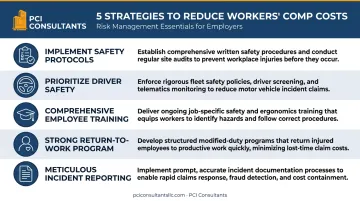
Document Rigorous Safety Protocols
- Use detailed checklists for ride inspection, assembly, and disassembly.
- Run mandatory daily safety briefings before the gates open.
- Enforce clear lockout/tagout procedures for all equipment maintenance.
Prioritize Driver and Travel Safety
- Enforce federal Hours of Service rules, including the 11-hour driving limit and required rest, to fight fatigue.
- Keep a strict maintenance program for every truck and transport vehicle.
- Train crews on safe loading and unloading.
Train Every Crew Member, Every Season
- Onboard new and seasonal staff on lifting technique, emergency shut-offs, and fire response before they touch a ride.
- Give role-specific training to operators, food handlers, and maintenance crews.
- Run refreshers through the season, not just at hire.
Report Every Incident Immediately
Every incident, however minor, should be reported the same day, because that is what lets us build the record and manage the claim from hour one. A Liberty Mutual study found claims reported 29 or more days after injury ran 52% more expensive than those reported within three days. On a traveling show, where a crew may be three states away by the time paperwork catches up, same-day reporting is the difference between a $30,000 claim and a lawyer number.
Choosing the Right Partner to Manage Your Carnival's WC Insurance
Given the complexity, a generic broker who binds a policy and disappears until renewal is not enough. You want a specialist who manages the claim directly and treats your loss run like a number worth defending.
For operators with a solid safety record, a high-deductible program can be a strong tool, for qualifying businesses. The idea: you take on a defined first layer of risk, say the first $200,000 of a $500,000 structure, and the insurer covers the rest. Doing so can roughly halve your annual premium, turning a six-figure spend into something closer to half that. Claim payments inside your layer are administered monthly, on the order of a few thousand dollars, and stop when the condition resolves. This is not a set-it-and-forget-it product, and not every business qualifies; it only works when someone is actively administering the claims every month. That is the part we do.
Smaller or newer shows are not shut out either. We regularly grow operators into these structures over time as their loss history and payroll support it. And because we handle claims in-house rather than routing you through an impersonal carrier queue, we can control losses and contest questionable claims far more aggressively than a large insurer that is content to pay and close.
The Concrete Next Step
If you want to know whether your carnival is overpaying, we do not start with a sales pitch. We start with your numbers. Send us two things:
- A copy of your current workers' comp policy.
- Your five-year loss runs.
With those, we can see how your payroll is classified, where your claims are actually costing you, and whether a restructured or high-deductible program fits. Then we handle the claims management from there. Individual results vary, but the review itself costs you nothing but the paperwork.
Frequently Asked Questions
How much does workers' compensation insurance cost for traveling carnivals?
It is high, and it is driven by your payroll, how each role is classified, and your claims history through the Experience Modification Rate. The premium itself is only half the story, though. What you pay next year depends heavily on how this year's claims are managed. A claim that gets settled at its inflated face value drives your rate up and keeps it there; the same claim managed down to its real cost protects it. Correct role classification and active claim handling are usually where the biggest savings hide.
What does workers' compensation not cover?
Comp generally excludes injuries that are self-inflicted, result from intoxication or drug use, happen during horseplay, or occur on a normal commute to a fixed local worksite. It is worth noting the difference between excluded and exaggerated: a genuine injury that is legitimately covered still gets paid without dispute. What gets challenged is a real-but-inflated or fabricated claim, and telling those apart quickly is exactly what active claims management is for.
Are seasonal and temporary carnival workers covered by workers' comp?
Yes. In nearly every state, seasonal, temporary, and part-time employees have the same right to coverage as permanent staff, from their first day. That is also why accurate payroll reporting by correct class code matters so much on a show that staffs up and down through the season.
What happens if an employee is injured while traveling between carnival locations?
Because travel is a required part of the job for carnival crews, injuries during that work travel are generally covered under the 'course and scope of employment' rule, unlike an ordinary commute. These in-transit and auto-involved claims are also where inflated figures appear fastest, so they are the ones most worth reporting and managing the same day they happen.
How can carnival owners lower their high workers' comp premiums?
Run a real safety program, report every incident immediately, and use a light-duty return-to-work program to get hurt workers back on the job in weeks. Beyond that, work with a partner who manages the claim directly and, for qualifying operators, explore a high-deductible structure that can roughly halve annual premium. Remember that premium tends to stay elevated once a claim pushes it up, so minimizing each claim is a multi-year saving, not a one-time one.
Does workers' compensation cover international travel?
Standard U.S. policies need a special endorsement for international travel. For carnivals moving domestically, the key is an 'Other States' endorsement, with every state of operation listed on the policy, so coverage follows your convoy across state lines.