But disputing a claim is not about fighting every injured worker. The insurance company won't frame it this way, but there is a sharp line between a legitimate injury that should be paid quickly and quietly, and an exaggerated or fraudulent one that should be investigated and contested. Get that line wrong in either direction and it costs you: pay a padded claim at face value and your premiums climb; stonewall a genuine injury and you invite litigation, penalties, and a worse loss run.
This guide walks through when an employer should dispute a workers' comp claim, how to do it correctly, and how to build the medical and factual record that protects you. It is written from 30+ years at PCI Consultants managing these claims directly for mid and large employers, mostly in healthcare, where injury frequency is highest.
Key Takeaways
- Pay legitimate injuries fast and without a fight; investigate and contest only the exaggerated or fraudulent ones.
- The number quoted early, the "lawyer number," is usually far higher than what the claim actually costs to resolve.
- A same-day urgent-care record is your single best protection against later exaggeration.
- Every claim feeds your experience mod, and premiums rarely come back down once they rise, so each claim is a multi-year cost.
- Left alone, insurers tend to pay claims at or near face value and call it a win; active claims management is what minimizes real spend.
Why Employers Dispute Workers' Comp Claims
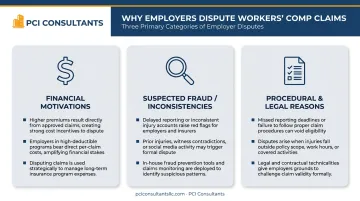
Understanding what is actually at stake helps you decide when to push back and when to pay. The reasons employers dispute claims are rarely personal. They come down to financial exposure, suspected exaggeration, or a procedural problem with how the claim was filed.
Financial Motivations
Workers' comp is insurance, and every dollar paid on a claim can raise what you pay for years. That happens through the experience modification rate, which compares your claims history to others in your class. More frequent or costly claims push your mod up, and a higher mod means higher premiums for years.
Here is the part the insurance company won't emphasize: once your premium rises after a claim, it rarely comes back down, even after the claim closes. That stickiness is why a single inflated claim is not a one-time expense; it is a multi-year cost baked into every renewal. So when you scrutinize a questionable claim, you are not being cheap. You are protecting a number that follows you.
The NCCI experience rating system is designed to reward workplace safety and clean loss history. It also means the difference between a claim resolved at its true cost and one paid at its inflated "face value" shows up directly in your mod.
Suspected Exaggeration or Fraud
Most injured workers are honest, and genuine injuries should be paid without dispute. But a share of claims are exaggerated or outright fraudulent, and those deserve a hard look. In a nursing home or home-health setting, common patterns worth investigating include:
- An injury reported days or weeks after the shift it supposedly happened on.
- No witnesses to an incident that occurred on a staffed floor.
- Details that shift between what the worker told the charge nurse, the doctor, and the adjuster.
- A pre-existing condition being presented as a fresh workplace injury.
- Off-the-clock activity that contradicts the claimed restriction, such as heavy lifting after a reported severe back injury.
The goal is not to deny people who are hurt. It is to separate the real claims from the padded ones so the real ones get paid fast and the padded ones do not quietly become part of your permanent loss history. Our approach to preventing fraudulent claims starts with an accurate record on day one, not an accusation later.
Procedural and Legal Reasons
Sometimes a claim is contestable simply because a rule was not followed. Missed state reporting deadlines, treatment sought outside an approved provider network where the state requires it, or an incident that falls outside the scope of employment can all be legitimate grounds. These are technical, not personal, and they have to be handled precisely to hold up.
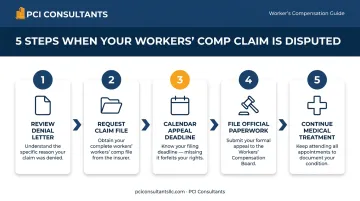
Your Step-by-Step Guide When You Decide to Dispute a Claim
The moment an incident is reported, the clock starts and the record starts forming. How you respond in the first hours often decides what the claim ultimately costs. Here is the sequence we run for the employers we manage.
Step 1: Evaluate the Incident Immediately
Do not wait to "see how it develops." When a worker reports an injury, the claim should be evaluated right away. In our model, the employer calls us, not the insurer, and we assess the incident on the spot. Speed here is what protects you, because the facts are freshest and no story has had time to grow.
Step 2: Create a Timely Medical Record
Where it is warranted, get the injured worker to urgent care the same day. A same-day, independent medical record is the single most powerful piece of evidence you can have. It documents the true nature and severity of the injury before anyone has an incentive to exaggerate it. Months later, when a claim quoted at $250,000 is really a soft-tissue strain, that day-one record is what anchors the real number. This is the heart of medical management done right.
Step 3: Separate the Legitimate Claim From the Inflated Number
Early claim valuations, the "lawyer number," are almost always inflated. A claim thrown out at $250,000 frequently resolves around $30,000 in actual medical spend, and that is not paid as a lump sum. It is paid incrementally, often in the range of $1,500 to $2,000 a month, and the payments stop when the condition resolves. Understanding this gap changes how you respond: you are not disputing that someone is hurt, you are disputing a number that was never real.
Step 4: Move Toward Light-Duty Return to Work
The fastest way to cut the true cost of a claim is to get the worker back in a productive role. An injured nurse who cannot lift patients can often move into a receptionist-type or administrative role within weeks. That return-to-work transition sharply reduces indemnity cost and shortens the tail of the claim, and it keeps a valued employee connected to your team.
Step 5: Document Everything and Manage the Claim to Close
A disputed claim is not a one-time filing; it is an active file that has to be administered. Keep the incident report, the medical records, witness statements, and a log of every communication. Left alone, an insurer's default is to pay the claim at or near face value and call it a win. Active claims management is what drives the outcome toward the claim's true cost.
Building a Defensible Case: Key Evidence
Whether you pay a claim or contest it, the record is what protects you. Your goal is a clear, contemporaneous file that reflects what actually happened.
Medical Records and the Day-One Report
This is the cornerstone. An objective, chronological medical history, starting with that same-day urgent-care or ER visit, is far harder to inflate than a diagnosis assembled weeks later. Gather the initial urgent-care report, notes from every visit and specialist consult, diagnostic results such as MRIs and X-rays, therapy progress notes, and a treating-physician statement on the injury and specific work restrictions. When the record starts on day one, the real cost of the claim is visible early.
Witness Statements and Co-worker Testimony
On a staffed healthcare floor, someone usually saw what happened, or saw that nothing did. Written, signed statements from co-workers who witnessed the incident, or its absence, carry real weight. Colleagues who can speak to the worker's physical condition and duties before the incident help establish an honest baseline.
Communication and Incident Records
Keep a dated log of every conversation with the worker, your HR team, and the adjuster. Save every email, text, and letter tied to the injury. Combined with the official incident report filed at the time, this paper trail is hard to dispute and makes both paying and contesting cleaner.
Critical Mistakes Employers Make During a Dispute
Disputing claims the wrong way is often more expensive than not disputing at all. The common errors we see:
- Fighting legitimate injuries. Contesting a genuine injury to save money backfires into litigation, penalties, and a worse loss history. Pay real claims fast; save your energy for the padded ones.
- Waiting to create the medical record. Every day without an independent medical record is a day the injury story can grow. The same-day visit is your protection, not a formality.
- Accepting the first number. Treating an early "lawyer number" as the real cost, or letting the insurer settle at face value, locks in a multi-year premium increase for a claim that was never that large.
- Skipping light duty. Leaving an injured worker fully off the job when a light-duty role exists inflates indemnity cost and drags out the claim.
- Handling it entirely alone. Going it solo has real trade-offs; see the pros and cons of handling a claim yourself before you decide.
The Role of a Claims-Management Partner
You can dispute a claim on your own, but you are up against an insurer whose default is to pay and move on. That is where handling the claim directly changes the math.
We Handle the Claim, Not Just the Policy
For the life of the policy, you call us, not the insurer. We evaluate the incident, direct the early medical care, and administer the claim to close. Because we are paid by commission from the insurer and not by your claims volume, we are not incentivized by how many claims you have, only by keeping your program healthy.
Paying the Real, Contesting the Padded
Genuine injuries get paid without a fight, quickly and quietly. Exaggerated or fraudulent claims get investigated and contested. That discipline protects your loss history and, by extension, the premiums you pay for years after a claim closes.
Structuring the Program So Claims Cost Less
Beyond individual claims, how your program is built matters. For qualifying businesses, a high-deductible or large-deductible program lets you take on a defined first layer of risk, for example the first $200,000 of a $500,000 policy, while the insurer covers the rest. That structure can roughly halve annual premium, and claim payments are made monthly and stop when the condition resolves. Not every business qualifies, and it only works when the claims are actively administered. Your workforce can also be segmented by real risk, clerical versus hands-on, so you are not overpaying on low-risk roles. Individual results vary.
Frequently Asked Questions
When should an employer dispute a workers' comp claim?
When the facts genuinely don't add up, such as a late report with no witnesses, shifting details, or activity that contradicts the claimed injury. Legitimate injuries should be paid promptly. The goal is to separate real claims from exaggerated or fraudulent ones, not to fight everyone who gets hurt. Individual results vary.
Is the amount quoted early in a claim the real cost?
Usually not. Early figures, the "lawyer number," are often inflated. A claim quoted at $250,000 may reflect closer to $30,000 in actual medical spend, paid incrementally at roughly $1,500 to $2,000 a month rather than as a lump sum, with payments ending when the condition resolves.
Can disputing a claim hurt us if we're wrong?
Yes. Contesting a legitimate injury can lead to litigation, penalties, and a worse loss run. That is why an accurate, timely medical record and a careful read of the facts come first, so you only contest what genuinely warrants it.
Why does a single claim matter so much to our premium?
Because of your experience mod and premium stickiness. A claim raises your mod, and once premiums rise they rarely come back down, even after the claim closes. That makes each inflated claim a multi-year cost, not a one-time expense.
Won't the insurance company protect our interests?
Not the way you'd hope. Left to their own default, insurers tend to pay claims at or near face value and call it a win. Minimizing the real cost takes an advocate who handles the claim directly and drives it toward its true value.
How do we get started with a claims review?
Send us your current workers' comp policy and your five-year loss runs. That lets us see your open claims and premium exposure and tell you where you're overpaying, what should be contested, and what should simply be paid. Reach out through our no-cost consultation to begin.