Choosing between them isn't a compliance box to tick. It's about fulfilling your Duty of Care and, just as importantly, controlling what an overseas injury actually costs you. Here's the part most brokers won't say out loud: buying the right policy is only half the job. What happens after someone gets hurt abroad, who manages the claim, how fast the medical record gets created, and whether anyone pushes back on an inflated number, is what really moves your loss history and your renewal. This guide covers both halves.
TL;DR: The Bottom Line on FVWC vs. BTA Insurance
- FVWC: Essentially workers' comp for employees working outside the U.S. It covers work-related injuries and illnesses, lost wages, rehabilitation and repatriation, and it protects your company from liability lawsuits. Built for expats and long-term assignments.
- BTA Insurance: A benefit policy covering accidental death, dismemberment, and often emergency medical for employees traveling on business. It covers incidents 24/7 for the whole trip, not just work hours, but it gives the employer no liability protection.
- Key Difference: FVWC is tied to the employment relationship and work-related incidents. BTA is a travel-specific benefit focused on accidents during the entire trip.
- The Takeaway most people miss: Which policy pays is only the start. An FVWC claim runs on the same cost mechanics as any workers' comp claim, and those are won or lost in how the claim is handled, not in the policy language.
Foreign Voluntary Workers' Comp vs. Business Travel Accident Insurance: Quick Comparison
To see the core differences at a glance, here's how these two policies stack up.
| Feature | Foreign Voluntary Workers' Comp (FVWC) | Business Travel Accident (BTA) |
|---|---|---|
| Scope of Coverage | Work-related injuries and occupational diseases abroad. | Accidents during business travel, often 24/7, including personal time. |
| Primary Benefits | Medical, lost wages, rehabilitation, and repatriation, typically paid over time as the claim runs. | Lump-sum payment for accidental death and dismemberment (AD&D). |
| Who is Covered? | U.S. employees on assignment, expats, and some third-country nationals. | Any employee traveling on company business, usually shorter trips. |
| Employer Protection | Yes. Liability protection and the "exclusive remedy." | No. A benefit policy with no liability protection for the employer. |
| Cost Basis | Premiums based on payroll, job risk classification, and countries of operation. | Flat rate per employee or based on total travel days. |
| Who manages a claim? | Someone has to. Left to the insurer, claims tend to get paid at face value. | Largely a payout policy; little ongoing claim management. |
What is Foreign Voluntary Workers' Compensation (FVWC)?
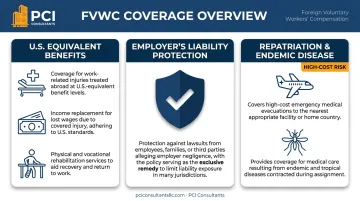
Domestic workers' comp policies stop at the U.S. border. FVWC fills that gap, extending U.S.-equivalent workers' comp benefits to employees injured while working overseas. Think of it as your domestic policy stretched to fit international risk, with the same benefit categories a hurt worker would get at home.
Primary FVWC Coverages
An FVWC policy delivers three essential kinds of protection:
- U.S.-equivalent workers' comp benefits, including medical treatment, lost wages, and rehabilitation for work-related injuries or illness abroad.
- Employer's liability protection against negligence suits from injured employees. This is what makes FVWC the "exclusive remedy," keeping a claim inside the comp system instead of turning into a separate tort lawsuit.
- Repatriation and endemic disease care, covering high-cost medical evacuations, which can exceed $100,000, plus treatment for endemic diseases like malaria or dengue that standard policies exclude.
Here's what the brochure won't tell you: an FVWC claim behaves like any other workers' comp claim once it's open, and that's exactly where cost either gets controlled or runs away. When a nurse on an overseas assignment strains her back lifting a patient, the number that lands on your loss run early, the "lawyer number," is almost always inflated. We've seen a claim reserved at $250,000 that, once managed properly, settled for roughly $30,000 in real medical spend, paid incrementally at around $1,500 to $2,000 a month, not as a lump sum. If nobody is challenging the reserve and directing the medical care, an insurer will often pay closer to the big number and call it a win. Individual results vary, but the pattern is consistent.
That's why, on the FVWC we place, we handle the claim directly for the life of the policy. When something happens abroad, the employer calls us, not a faceless carrier line. We evaluate the incident immediately and, where it's warranted, get the worker into appropriate urgent care right away so there's an accurate, timely medical record, the single best protection against a minor injury being exaggerated weeks later. FVWC can be bought standalone or as an endorsement on your domestic policy; the right structure depends on the scale of your international operations and how your workforce is classified by actual risk, so you're not overpaying to insure clerical staff at a hands-on rate.
What is Business Travel Accident (BTA) Insurance?
Business Travel Accident (BTA) insurance works like a specialized life or disability policy built specifically for accidents during business travel. It's a financial safety net for employees and their families when something goes badly wrong on a trip.
Unlike FVWC, which is about work-related incidents, BTA is "portal-to-portal." An employee is typically covered from the moment they leave home for a business trip until they return, including leisure time on that trip.
Core BTA Benefits
The main features of a BTA policy:
- A lump-sum benefit for accidental death or dismemberment, often a multiple of the employee's salary.
- Emergency medical costs and medical evacuation to a suitable facility, up to the policy limit.
- 24/7 travel assistance for crises like lost passports, legal referrals, or security emergencies.
The crucial limitation: BTA is an employee benefit, not liability protection. It's a genuine comfort to your team, but it does nothing to shield your company from a lawsuit tied to a travel incident. And because it's largely a payout policy, there's no one actively managing an open claim the way there is with well-administered workers' comp, which is fine, because that isn't what BTA is for.
FVWC vs. BTA: Which Policy Do Your Employees Need?
The right answer depends on the situation. Let's walk through three common scenarios.
Scenario 1: The Short-Term Business Trip
A clinical director from your New York office flies to London for a one-week conference. The activities are low-risk, meetings, networking, a presentation.
Recommendation: A solid BTA policy is likely enough. It provides 24/7 accident coverage, from a slip in the hotel to a traffic accident on the way to the airport, plus emergency medical and travel assistance, which are the realistic needs on a short, low-risk trip.
Scenario 2: The Long-Term International Assignment
You're relocating an operations manager to Germany for a two-year assignment to stand up a new facility. They'll live and work there as an expatriate.
Recommendation: FVWC is non-negotiable. This person is effectively working full-time in a foreign country and needs full workers' comp for on-the-job injuries, plus employer's liability protection under foreign law. A report from RIMS confirms FVWC is the proper tool for expatriates on long-term assignments. And over a two-year window, this is exactly the kind of exposure where active claims management pays for itself, because a single mishandled injury can lift your premium and keep it lifted long after the person comes home.
Scenario 3: The High-Risk or Frequent Traveler
A traveling nurse or field clinician from your multi-state staffing operation works assignments in developing regions for 2 to 3 weeks at a time. The work is physically demanding, patient handling, long shifts, and local medical facilities are limited.
Recommendation: This employee needs both BTA and FVWC.
- FVWC covers work-specific injuries on assignment, exposure to endemic disease, and the high cost of medical repatriation, and it's the policy where a strong return-to-work program matters most. Transitioning an injured clinician into a light-duty role within weeks, rather than leaving them off entirely, sharply cuts the real cost of the claim.
- BTA provides 24/7 protection for non-work accidents and can cover personal travel attached to a business trip, a gap FVWC doesn't touch.
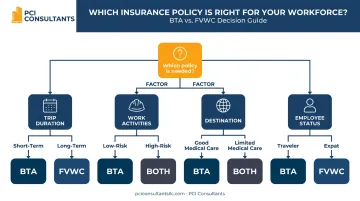
To make the right call, weigh these four factors:
- Trip Duration: Short trips lean BTA; long-term assignments demand FVWC.
- Work Activities: Office work is far lower risk than patient handling or manual labor in hazardous environments.
- Destination Country: How good is local medical care? Are there endemic diseases?
- Employee Status: U.S. employee, expat, or third-country national?
The Part Nobody Prices In: Who Handles the Overseas Claim
Most of the FVWC-vs-BTA conversation stops at coverage definitions. That's the easy part. The expensive part comes after an injury, and it's the same lesson we teach on domestic workers' comp: once a premium goes up after a claim, it rarely comes back down, even after the claim resolves. That's a multi-year cost, not a one-time hit, and it's why the way a claim is handled matters far more than which brand is on the policy.
Left alone, an insurer's default is to pay a claim at or near its face value and move on. There's no advocate in the room asking whether that $250,000 reserve reflects a real $30,000 of medical spend, whether the injured worker can return in a light-duty role, or whether an exaggerated claim deserves to be contested. That's the role we play. Genuine injuries get paid without a fight, that's the deal, and we make sure the worker is treated properly. But when a claim is exaggerated or fraudulent, we investigate and push back, which protects both your loss history and your future premiums. One note worth stating plainly: we're paid by commission from the insurer, not tied to your claims volume, so we're not incentivized to let claims run. Our incentive is the same as yours, keeping your program clean and your costs down.
Building a Comprehensive Duty of Care Program
The goal isn't to crown a "winner" between FVWC and BTA. It's a program that protects your people from every angle without paying twice for overlapping coverage. Often the right move is layering both policies, then classifying your workforce by real risk so a low-risk traveler isn't rated like a high-risk one. Getting this wrong exposes you to real financial and legal risk; getting it right is largely about disciplined loss control and claims management.
At PCI Consultants, we've spent 30-plus years managing complex workers' comp and liability risk, and we do it hands-on. For your international program, we:
- Audit your current policies to find the gaps in your overseas coverage.
- Design a cost-effective structure through A+ rated carrier partners, sized to your actual travel and assignment patterns.
- Handle the claim directly for the life of the policy, so an injury abroad becomes a phone call to us, not a number that quietly inflates on your loss run.
The concrete next step is simple: send us a copy of your current workers' comp policy and your five-year loss runs. That's everything we need to review your international exposure, spot what you're overpaying for, and show you exactly where FVWC, BTA, or both belong. Not every business needs the same structure, and we'll tell you plainly what yours does. Individual results vary.
Frequently Asked Questions
What does foreign voluntary workers' compensation cover?
It covers work-related injuries and illnesses for employees abroad, including medical costs, lost wages, rehabilitation, repatriation, and employer liability protection. It functions like a U.S. workers' comp policy, but for international work, and the claim itself runs on the same cost mechanics, meaning benefits are typically paid incrementally over time, not as a single lump sum.
What does business travel accident insurance cover?
It's a benefit policy covering accidental death, dismemberment, and emergency medical for employees traveling on business. Coverage usually applies 24/7 for the whole trip, including personal time, but it offers no liability protection for the employer and no ongoing claim management.
Is an injury during business travel considered a workplace injury?
If it happens while performing job duties, it's work-related and becomes an FVWC claim. If it occurs during personal time, like sightseeing, it typically falls under a BTA or travel medical policy. The distinction matters, because a work-related claim affects your loss history and future premiums, which is exactly why it should be actively managed rather than paid at face value.
Do we need both FVWC and BTA insurance for our employees?
Often, yes, especially for frequent or high-risk travelers such as traveling clinicians. BTA gives 24/7 accident coverage for the entire trip; FVWC provides the essential liability protection and workers' comp benefits for work-related incidents. Together they close the gaps, and we help you layer them without buying overlapping coverage.
Does FVWC cover personal activities during a business trip?
No. FVWC only covers incidents "in the course of employment." Accidents during personal activities, like sightseeing or non-work travel, aren't covered and would require a BTA policy.
How do you keep an overseas workers' comp claim from raising our premium?
We handle the claim directly the moment it happens, evaluating the incident and, where appropriate, getting the worker into urgent care right away to create an accurate, timely medical record. We challenge inflated reserves, support fast light-duty return to work, pay legitimate injuries without dispute, and contest exaggerated ones. Because premiums rarely come back down once they rise, controlling the claim early is what protects your cost for years. Individual results vary.