Here is the part the insurance company will not tell you: left to their own devices, carriers tend to pay a claim at or near its face value, call it a "win," and move on. The reserve they set — the number a plaintiff's attorney would love to quote — often has little to do with what the injury actually costs. An IME, used at the right moment inside an active claims process, is one of the clearest ways to close that gap.
This article covers what an IME is, why insurers request one, what to expect at the appointment, how to protect a legitimate claim, and how healthcare employers can use IME outcomes to control real claim cost — not just the number on the reserve sheet.
Key Takeaways
- An IME is ordered by the insurer or employer — not the worker's own doctor — to get an independent medical opinion on the claim
- Attendance is legally required in most states; refusal can suspend benefits
- The IME's real value is not "denial" — it is establishing the true, incremental cost of a claim versus the inflated reserve
- Genuine injuries should be paid without a fight; exaggerated or fraudulent claims are where an IME earns its keep
- Employers who fold IMEs into an actively managed claims management program — with a light-duty return-to-work plan ready — get far better outcomes than those who order exams reactively. Individual results vary.
What Is a Workers' Comp Independent Medical Examination?
An IME is a medical-legal evaluation requested by a workers' compensation insurer, self-insured employer, or state workers' comp agency and performed by a physician who has not previously treated the injured worker. Washington State defines it as an objective exam designed to establish medical findings, opinions, and conclusions about the worker's physical condition.
The stated purpose is straightforward: an independent opinion on the injury's cause, severity, appropriate treatment, and whether it actually prevents the worker from doing the job.
What the IME Is Not
A few distinctions separate an IME from a regular medical appointment:
- No doctor-patient relationship — the AMA's ethics guidance on work-related exams describes this as a "limited patient-physician relationship," and Oregon requires IME providers to explicitly tell workers no ongoing relationship will be established
- No confidentiality — the report goes straight to the insurer, employer, and potentially a workers' comp judge
- No treatment — the physician is evaluating the claim, not managing care
Why the IME Matters More Than the Reserve
Here is the mechanism most owners never see. Say a home health nurse strains her back lifting a patient. The carrier opens a reserve at $250,000 — the "lawyer number," the figure that assumes surgery, permanent disability, and a plaintiff's attorney. Left alone, the insurer may well pay toward that number and count it as resolved.
But the real medical spend on that injury, actively managed, is often closer to $30,000 — and it is not written as a lump sum. It is paid incrementally, frequently in the range of $1,500 to $2,000 a month, and payments stop when the condition resolves. An IME is one of the tools that documents what the injury actually is, so the claim gets valued against reality instead of the worst-case reserve. That difference is not academic: once your premium rises after an inflated claim, it rarely comes back down — you carry it for years. Individual results vary, but the pattern is consistent.
Because we are paid by commission from the insurer and not tied to your claims volume, we have no incentive to let a $30,000 injury settle as a $250,000 event. Our interest is the same as yours: an accurate number.
Why Do Insurance Companies Request an IME?
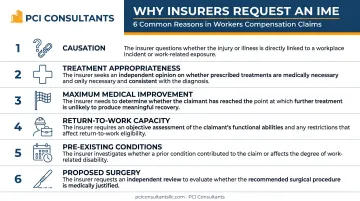
Understanding why an IME gets ordered is the first step toward managing its outcome. Insurers request IMEs when a claim raises a specific question they want an independent answer to — usually one or more of the following:
- Causation: Is the injury actually work-related, or a pre-existing degenerative condition?
- Treatment appropriateness: Is ongoing treatment medically necessary?
- Maximum Medical Improvement (MMI): Has the worker recovered as much as they are going to?
- Return-to-work capacity: Can the worker perform their duties, or a light-duty version of them?
- Pre-existing conditions: Is the claimed injury really a prior problem?
- Proposed surgery: Is an expensive procedure genuinely necessary?
The Day-One Record Beats the Late IME
An IME ordered at month six is damage control. The stronger play happens on day one. When a caregiver reports an injury, the fastest way to protect both the worker and the employer is an accurate, timely medical record — which is why we often send the injured employee to urgent care immediately. That contemporaneous record establishes what the injury was before anyone has an incentive to exaggerate it. When an IME follows later, it has a clean baseline to measure against instead of eight months of unmanaged notes. Reactive IMEs fight uphill; documented claims do not.
How Often Can an IME Be Ordered?
Frequency limits vary significantly by state:
| State | IME Frequency Rules |
|---|---|
| Florida | One IME per accident per party |
| Texas | Generally once every 180 days absent good cause |
| Wisconsin | Every 6 months is considered reasonable |
| Oregon | Attendance is mandatory; failure to attend can trigger a $100 penalty |
Beyond scheduled intervals, insurers may request additional IMEs when significant changes occur: a new surgery, a permanent disability assessment, a shift in treatment direction, or a disputed return-to-work timeline. State rules on frequency are the employer's first line of defense against excess examinations — confirm the limits in your jurisdiction before agreeing to, or disputing, a request.
What to Expect During the IME Appointment
The Examination Itself
IME appointments follow a consistent structure. The physician will typically:
- Review the full medical history and records before or during the appointment
- Conduct a physical examination focused on the claimed injury
- Perform functional tests — bending, lifting, range-of-motion — to evaluate limitations
- Ask about symptoms, treatment history, and daily restrictions
The doctor is assessing consistency throughout — not just during the physical exam. How the claimant walks in, answers questions, and behaves in the waiting room can all factor into the report. In practice, the examination begins the moment they arrive.

Claimant Rights at the IME
Employers managing the process should understand the rights claimants hold — these vary by state but commonly include:
- Observer: Most states allow a family member, friend, or personal physician to accompany the worker (with restrictions for psychological exams)
- Interpreter: Workers with language barriers generally have a right to an interpreter — relevant across a diverse healthcare workforce
- IME report copy: The worker is typically entitled to a copy of the report
- Travel reimbursement: Washington and Texas reimburse travel and lost wages for the exam; Wisconsin requires the insurer to pay costs in advance
- Refuse invasive procedures: Oregon explicitly allows refusal of invasive procedures without affecting benefits
- Recording: Oregon permits recording only if the IME provider approves; most states impose similar limits
Note the tone here: none of this is about denying legitimately hurt caregivers. A genuine injury should be paid, and paid without a fight. The rights above protect the honest worker; the IME protects everyone else from the exaggerated one.
Dos and Don'ts to Protect the Claim
What Employers Should Do
Request the IME proactively. Do not wait for a claim to plateau. When a nurse's reported limitations seem inconsistent with the documented injury, an early IME establishes an objective baseline before the gap widens.
Choose the examining physician carefully. Select a board-certified specialist whose credentials match the injury — an orthopedic surgeon for a back claim, a neurologist for a head injury. A mismatched specialty weakens the report if the claim goes to dispute.
Provide complete records. Send the full file — prior treatment, imaging, and any surveillance or investigation documentation. An examiner working from incomplete records produces an opinion opposing counsel can pick apart.
Document all scheduling communications. Notify the claimant in writing, confirm receipt, and log reschedule requests. A no-show only helps your defense if the paper trail is clean.
What Employers Should Avoid
Don't use the IME as a blanket denial tool. State boards scrutinize patterns. If every IME from one employer recommends denial, it signals the exam was built to reach a predetermined result. Pay the real injuries; contest the exaggerated ones. That distinction is what keeps your program credible.
Don't ignore findings that complicate your position. If the examiner identifies a legitimate ongoing condition, address it. Managing the true cost means paying what is owed — the goal is an accurate number, not the lowest possible one.
Don't skip the return-to-work conversation. An IME that establishes functional capacity is only useful if you have modified duty ready. According to the California Department of Insurance, claim duration — not just initial severity — is a primary driver of total cost. Transitioning an injured nurse into a receptionist-type light-duty role within weeks, rather than leaving her out for months, sharply cuts the real claim cost. Pair the IME with a structured return-to-work program and you control the single biggest cost variable in the file.
Understanding and Challenging the IME Report
What the Report Contains
After the exam, the physician compiles a written report covering:
- Causation (whether the injury is work-related)
- Severity and current functional limitations
- Appropriateness of ongoing treatment
- Disability extent and work restrictions
- Return-to-work opinion or MMI determination
In Florida, an IME physician must provide a written report for their opinions to be considered at a final hearing. Workers' comp judges often give IME reports substantial weight — sometimes above the treating physician's opinion.
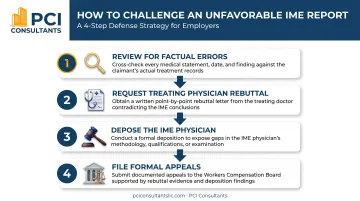
How to Challenge an Unfavorable Report
An unfavorable report can be challenged through several avenues:
- Review for factual errors — wrong dates, misquoted symptoms, or incorrect history can be challenged in writing with supporting documentation
- Request a treating physician rebuttal — present the report to the treating doctor for a written response to specific findings
- Deposition of the IME doctor — through counsel, you may depose the physician and challenge methodology or conclusions
- Formal appeals process — unresolved disputes go through the workers' comp hearing and appeals process
This cuts both ways. If you are the employer and the IME complicates your position, the same avenues apply. And in some states claimants can request a second exam — New York's WCL 137 sets standards for examiner competence, report procedures, and settings. Knowing these rules helps you anticipate disputes and prepare a stronger position before a hearing, whether the claim heads toward litigation or settles.
How Healthcare Employers Use IME Outcomes to Manage Cost
For employers, IMEs verify that claims are compensable, accurately valued, and moving toward appropriate resolution. The question is not whether to use them — it is whether you use them strategically or reactively.
Separate the Genuine From the Exaggerated
Nursing homes, home health agencies, and hospitals carry the highest injury exposure of any industry — lifting, transfers, needlesticks, slips. Most of those injuries are real, and they should be paid. The cost problem is concentrated in the minority of claims that are exaggerated or fraudulent: the strained back that never improves on paper, the return-to-work refusal with no medical basis, the attorney who appears in week one.
The red flags that should trigger an IME include:
- Prior claims history from the same employee
- Attorney representation entering unusually early
- Treating-provider patterns associated with prolonged or inflated claims
- Injury-mechanism inconsistencies
- Return-to-work refusal without medical justification
Genuine claims flow through without dispute. The flagged ones get investigated. That is how you protect your loss history — and, downstream, your future premiums — without treating hurt caregivers as suspects.
The Difference Active Management Makes
Here is what most owners do not realize: when you carry standard coverage, you call the insurer and hope. In an actively managed program, you call us — for the life of the policy — and we handle the claim directly. We evaluate the incident immediately, create the day-one record, coordinate the IME at the right moment, and drive toward light-duty return to work. A claim caught at week three looks nothing like the same claim at month eight.
Each IME report then feeds a defined path:
- Pay and resolve where the medical evidence supports a genuine injury
- Settlement at a defensible, documented value — the real number, not the reserve
- Full defense through hearing where an exaggerated claim warrants it
The same discipline connects to how your program is priced. Segmenting your workforce by actual risk — clerical and administrative staff scored separately from hands-on caregivers — keeps you from overpaying on low-risk roles. For qualifying larger healthcare operators, a high-deductible program can take on a defined first layer (say the first $200K of a $500K tower) with the insurer covering the rest, roughly halving annual premium; those claim payments are administered monthly, around $3,000 a month, and stop when the condition resolves. Not every business qualifies, and individual results vary — but for the right operator, actively managed IME timing and high-deductible structure work together.
Ready to See Your Own Numbers?
If you run 100-plus employees and spend $100,000 or more a year on workers' comp, the fastest way to know what a managed approach would change is a review of your actual file. Send us two things: a copy of your current workers' comp policy and your five-year loss runs. We will show you where your open claims are valued against the lawyer number instead of the real one — and what that is costing you at renewal. Explore our advisory and claims services to see how the full program fits together.
Frequently Asked Questions
What does independent medical exam mean?
An IME is a medical evaluation ordered by a workers' comp insurer or employer and conducted by a physician with no prior involvement in the worker's care. Its purpose is an independent opinion on the nature, severity, and work-relatedness of the injury — not treatment. In an actively managed program it is one tool for valuing a claim at its real cost rather than the inflated reserve.
How do you "pass" an independent medical examination?
There is no passing or failing. A worker should show up on time, describe all symptoms accurately, follow the treatment plan, and neither exaggerate nor downplay. Consistency between what is reported and what the medical record shows is what matters — which is exactly why a timely, accurate day-one record protects an honest claimant.
Do I have to attend an IME for workers' comp?
In most states, yes. Attendance is a legal condition of receiving benefits. In New Jersey, California, Florida, Texas, and Oregon, refusal can suspend or bar compensation during non-compliance. Check your state's specific rules before considering non-attendance.
Can I bring someone with me to an IME?
Most states allow an observer — a spouse, family member, or personal physician — though they typically cannot interfere with the exam. Some states, like Oregon, add restrictions for psychological exams. Verify your state's rules beforehand.
As an employer, will an IME lower my premium?
Not directly, and not overnight — individual results vary. What an IME does is help value a claim accurately, so a $30,000 injury is not carried as a $250,000 event. Because premiums rarely fall back down once an inflated claim pushes them up, valuing claims correctly and returning workers to light duty quickly is how you protect your loss history and your future renewals over multiple years.
How long does an IME typically take?
The actual examination is often brief — sometimes under 15 minutes — despite the report's weight. Track how long the doctor spends examining you and note anything that felt incomplete; that detail can matter if the findings are later disputed.